Introduction
Walk any major food trade show floor — Natural Products Expo West with its 66,000+ attendees and 3,200+ exhibitors, or the Summer Fancy Food Show drawing 9,000+ buyer attendees across 345,000 square feet — and one thing becomes obvious fast: every exhibitor has a 10x10 booth, a product on display, and about three seconds to make a buyer care.
So what actually makes a buyer stop?
The answer isn't luck or foot traffic. It's layout, visual clarity, and a sampling experience that pulls people in rather than letting them drift past.
Most food brands treat booth design as an afterthought — something to sort out two weeks before the show. By then, it's too late to get it right.
This article covers specific, food-brand-relevant layout configurations, sampling placement strategy, packaging display tactics, and signage hierarchy — everything built around the 10x10 format. This is show-floor strategy for brands trying to land buyers, distributors, and brokers — not generic vendor fair advice.
Key Takeaways
- The best 10x10 food booth layouts balance sampling access, SKU visibility, and space for brief buyer conversations
- Position sampling at the front of your booth, not the back — dwell time follows the sample
- Treat your back wall as a retail shelf — packaging must look shelf-ready and brand-consistent
- Consistent visuals across every booth element build credibility with buyers at a glance
- Always verify show-specific food handling and equipment rules before finalizing your setup
What a 10x10 Booth Space Actually Gives You
A 10x10 booth is 100 gross square feet — roughly the footprint of a small room. IAEE identifies this as the standard linear booth size, with inline booths flanked by neighbors on the left and right, leaving one aisle-facing side open to foot traffic. Corner booths are the exception: they sit at the end of a row with two aisle exposures.
The Food Brand Squeeze
For most exhibitors, 100 square feet is manageable. For food brands, the same space has to accommodate:
- A sampling or demo table
- Coolers, warmers, or serving equipment
- Product display (packaging, shelving, back wall)
- Staff movement and buyer conversation space
- Lead capture tools and marketing materials
Five competing priorities in 100 square feet — the layout decisions start before the show floor opens.
Before finalizing any layout, check your show's specific height rules. Standard IAEE guidelines allow an 8-foot back wall in the rear half of the booth, with materials in the front 5 feet capped at 4 feet in height. Individual shows often deviate from that baseline, so confirm the details in your exhibitor services manual before committing to a display design.
Best 10x10 Booth Layout Configurations for Food Brands
The right layout depends on three variables: whether you need active sampling, how many SKUs you're showcasing, and whether you have a corner or inline position. Here are the four configurations that work best for food brands.
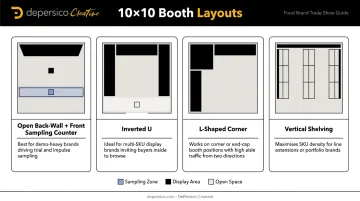
Open Back-Wall + Front Sampling Counter
This is the most practical starting point for most food exhibitors. A branded back wall anchors the booth with your logo, packaging, and key messaging. A 6-foot sampling counter runs across the front, giving buyers an immediate interaction point when they approach.
The visual hierarchy is clean: buyers see the brand story at a glance, then engage with the product at the counter. Works especially well for brands with 1–3 hero SKUs.
Critical execution detail: Don't let the front counter become a wall. Position it 1–2 feet inside the aisle edge, and have staff work from the sides of the table rather than standing behind it. A counter that blocks entry signals "transaction" — a counter that invites entry signals "conversation."
Inverted U (Open Front, Products on Sides and Back)
Tables or shelving line the back and both sides, leaving the front completely open. Buyers naturally walk in rather than stopping at a barrier.
This layout works well when:
- You're showcasing 5+ SKUs that buyers need to browse
- You need floor space for a refrigerated cooler or warming equipment
- Your product requires a longer conversation than a quick sample exchange
The open front is a genuine draw: Freeman notes that letting visitors touch, test, or try a product builds confidence, and a layout that physically invites people to step inside removes the first barrier to that interaction.
L-Shaped and Corner Booth Layouts
If you secure a corner booth position, the L-shaped configuration gives you maximum aisle visibility. Two display surfaces face the walkways on two sides. Use one as your brand story wall (packaging, photography, hero claims) and the second as the sampling interaction zone.
Place your tallest brand element — a retractable banner, shelving tower, or back-wall graphic — at the junction point of the two sides. That corner becomes a visual landmark on the show floor, visible from 30+ feet away.
Vertical Shelving for Multi-SKU Lines
A sauce brand with 8 flavors or a snack brand with 6 format variations will quickly outgrow a flat table display. Tiered shelving or modular systems let every SKU show at or near eye level, mimicking the retail shelf display.
This layout works best when paired with a back-wall graphic showing the full brand identity. Buyers should see individual products and the brand story simultaneously. A wall of products without context doesn't sell the brand.
Food Sampling and Buyer Engagement in a 10x10 Space
Freeman's 2024 survey of 2,002 B2B trade show attendees found that 80% viewed in-person events as their primary source for discovering new products. At a food show, sampling is the mechanism that converts "discovering" into "remembering."
But placement matters more than most brands expect.
Sampling Station Placement and Flow
Position sampling at the front-center or front-left of the booth — visible from the aisle. A small visual cue (a cutting board, a warm server, branded sample cups in view) signals "come taste this" without requiring visitors to fully commit to entering the booth.
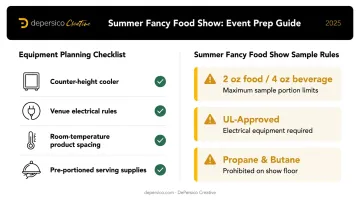
Equipment planning checklist:
- Use a counter-height cooler for refrigerated products — it doubles as a serving surface
- Confirm venue rules on electric warmers vs. open flame before packing heated product equipment
- Reserve dedicated space for room-temperature products away from buyer conversation areas
- Pre-portion and stock serving supplies before the floor opens — restocking mid-show cuts into conversation time
For the Summer Fancy Food Show specifically, the current rules include:
- Sample limits: 2 oz for food, 4 oz for non-alcoholic beverages
- All electrical equipment must be UL approved
- Propane and butane are prohibited; open flame requires a Javits permit
Always check the SFA's current sampling and cooking rules before finalizing your setup. Rules at Expo West and other venues will differ.
Staff Positioning and Buyer Conversation Strategy
At a B2B food show, your audience is buyers, distributors, and brokers — not end consumers. Every sample should open a conversation, not just a snack break — the measure of success is a buyer stepping inside to review your full line.
Position staff accordingly:
- One person at the sampling station — offering the product, making brief first contact
- One person inside the booth — available for deeper conversations near the product display wall, where they can reference packaging, category claims, and the broader line
A buyer who tries a sample and steps inside to browse your full line is worth far more than ten people who grab a snack and keep walking. Design the layout so moving from the sample station to the display wall feels like a natural next step.
How Your Packaging and Brand Visuals Function as Booth Display Assets
At a food trade show, retail buyers are making fast judgments about whether a product belongs on their shelves. They're not reading brochures from a distance — they're scanning the show floor, filtering by visual confidence and brand readiness.
Your packaging is doing most of that work.
Making Packaging the Hero of Your Back Wall
An actual shelf-set display of your full product line on the back wall gives buyers immediate retail context. They can visualize your product in their store without any pitch required. Oversized packaging photography works similarly — it communicates scale, appetite appeal, and brand confidence at a glance.
This only works with high-resolution, professionally shot imagery. Smartphone photos scaled to a 10-foot back wall expose every flaw.
DePersico Creative's Sea Best® rebrand is a useful reference point here. The project included a custom trade show booth built to match the new brand identity, so the visual system appearing on retail shelves carried through the entire show floor with full consistency.
The honest question food brands should ask before any major show: does your current packaging create desire when someone sees it from 15 feet away? If not, that's worth resolving before committing to booth space and travel costs.
Color, Messaging, and Visual Consistency Across the Booth
Every visual element in the booth should pull from the same color palette as your packaging — tablecloths, banners, sample cup holders, staff shirts. When the visual system is consistent, the booth reads as a serious, shelf-ready brand. When it's not, buyers notice, even if they can't articulate why.
Booth signage hierarchy that works:
| Level | Content | Visibility Target |
|---|---|---|
| Top (brand name + logo) | Brand identity | Legible from 20+ feet |
| Middle (tagline or claim) | Single value statement | Readable from 10 feet |
| Bottom (flavor/variant callouts) | Product specifics | Near the actual product |
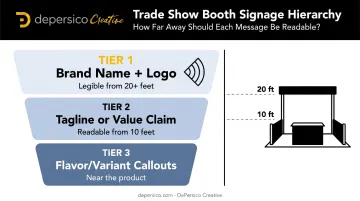
One compelling claim in the middle, not five bullet points. Buyers are moving fast. Your messaging has seconds to communicate value.
DePersico Creative's food branding work applies the same logic that drives retail shelf performance: a strong brand lockup, clear visual hierarchy, and front-panel messaging stripped to what matters most. The booth functions as a shelf — and should be designed with the same discipline.
Lighting, Signage, and Atmosphere for Food Brand Booths
Convention hall lighting varies by venue and can't be assumed. At the Anaheim Convention Center (Expo West's home), ACC North uses LED show lighting at 80 foot-candles, while other halls use metal-halide fixtures. Javits Center references energy-efficient lighting but doesn't certify output levels for exhibit floors. Don't rely on ambient hall lighting to make your product look appetizing.
Targeted lighting options to consider:
- Clip-on LED spots aimed at your sampling station and product display
- Backlit display graphics for the back wall
- Under-shelf lighting for product shelving
Check show-specific rules before purchasing. At the Summer Fancy Food Show, sealed halogen lamps are capped at 75W and strobes are prohibited; electricity is ordered separately through Javits. At Expo West, exhibitor-supplied lights require ordered power with a 5-amp minimum outlet.
The Aisle Test
Before the show opens, walk 30 feet from your booth and ask three questions:
- Is your brand name legible?
- Does the product look appetizing?
- Is there a clear reason to walk over?
If any answer is no, something needs adjustment: more targeted lighting, larger signage, or a more prominent hero product visual. Food also has one advantage most categories don't: if your product has a recognizable aroma when sampled or warmed, that ambient cue can work as a draw before a buyer even looks in your direction.
Frequently Asked Questions
What is the best layout for a 10x10 food brand booth?
For most food exhibitors, the back-wall + sampling counter or the inverted U configuration works best — both put sampling at the front and leave room for buyer conversations. The right choice depends on your SKU count and whether buyers need to browse a range or focus on one or two hero products.
How big is a 10x10 booth space?
A 10x10 booth is 100 gross square feet. For food brands, the usable working area is smaller once sampling equipment, display tables, and staff movement are factored in — which means every square foot needs a deliberate purpose.
What size table should I use in a 10x10 booth?
A 6-foot table (the standard) works well for most food brand configurations, positioned across the front or along one side. A 4-foot table may be preferable if you need more open floor space for sampling interaction or refrigeration equipment.
How do you incorporate food sampling into a 10x10 booth?
Position sampling at or near the front of the booth so it's visible from the aisle. Plan equipment placement (coolers, warmers, serving supplies) in advance so it doesn't consume space you need for buyer conversations. Always verify the show's food handling and sampling rules before finalizing your setup.
How can a food brand stand out at a trade show booth?
The most effective differentiators:
- Shelf-ready packaging displayed prominently on the back wall
- A single clear value claim in large, readable signage
- Targeted lighting on sampling stations and hero products
- A sampling experience that naturally draws buyers inside for a conversation
What should a food brand bring to a trade show booth?
Core essentials:
- Product samples and branded serving supplies
- Back wall display and signage
- Product packaging for shelf-set display
- Lead capture system (tablet or business cards)
- One-page sell sheets for buyers
- Refrigeration or heating equipment required for safe sampling at that show