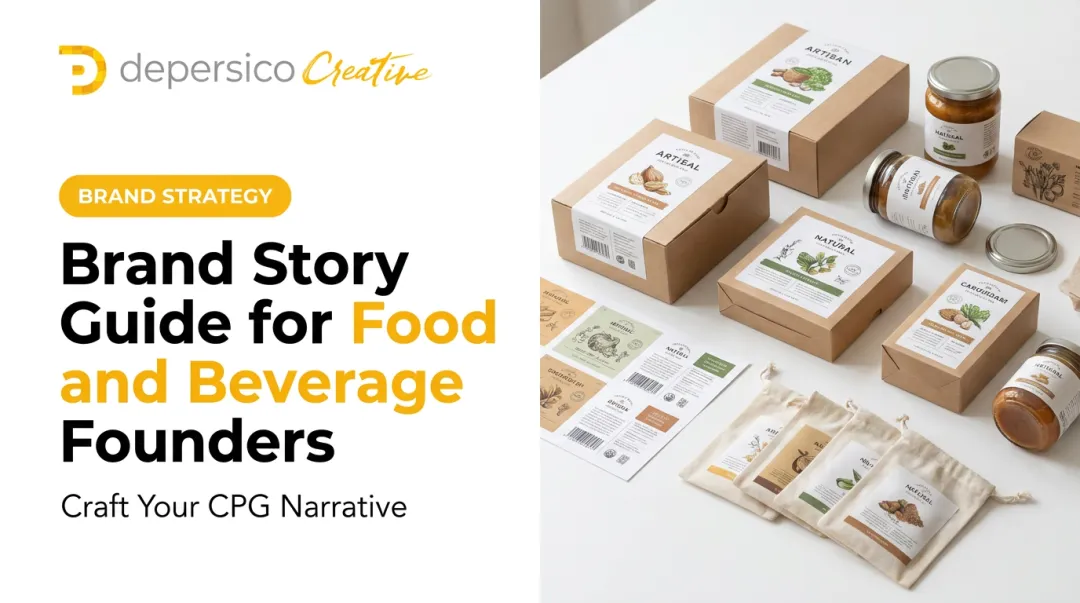
The problem is that most food and beverage brands invest heavily in product development and almost nothing in the narrative that makes someone reach for their product over the one next to it. A superior product with no story is just another option on a crowded shelf.
This article explains what a brand narrative is, why it's especially powerful in the food and beverage category, what it's made of, and how to build one that actually works at the speed of a shelf decision.
Key Takeaways
- A brand narrative is a strategic messaging framework that drives emotional connection with consumers — distinct from a tagline or mission statement
- In F&B, narrative must function in seconds, woven into every touchpoint, especially packaging
- Strong narratives are built from origin, values, audience connection, sensory hooks, and deliberate language
- Brands without a narrative compete on price; those with one build loyalty and command premium positioning
- A brand narrative is a living framework, not a one-time document
What Is a Brand Narrative?
A brand narrative is a concise, strategic story framework that captures who a brand is, why it exists, what it believes in, and how it speaks. It provides the foundation for every piece of marketing and communication a brand produces.
That definition matters because of what a brand narrative is not.
- Not a tagline — a tagline is a compressed expression of a narrative, not a substitute for one
- Not a mission statement — that's an internal declaration of purpose
- Not an origin story — a single founding tale is one element within a narrative, not the whole thing
- Not a product description — features describe what's inside; narrative creates the emotional reason to care
A brand narrative informs all of these. It's the strategic layer above them: the framework that ensures your tagline, your packaging copy, your social content, and your in-store presence all say the same thing in the same voice and create the same feeling.
A well-built brand narrative creates consistent emotional resonance across every consumer touchpoint — so whether a shopper encounters your brand on a shelf, in a social ad, or in a retailer's trade presentation, they recognize it, trust it, and choose it.
Why Brand Narrative Matters for Food and Beverage Brands
Food is not a neutral purchase category. It's tied to memory, identity, comfort, and culture in ways most other products aren't.
A sauce can remind someone of their grandmother's kitchen. A snack bar can signal who they're trying to become. A beverage can mark a ritual, a celebration, or a treat. That emotional charge makes brand narrative both uniquely powerful and uniquely necessary in this space.
The Shelf Reality
A grocery shopper isn't reading. They're scanning. And that scan happens fast. Without a compelling narrative embedded in the brand's visual and verbal identity, there's no emotional hook to interrupt that motion.
Research on food packaging storytelling found that graphic storytelling on packaging increased narrative transportation — the psychological state where a consumer becomes absorbed in a brand's story — and that transportation directly increased purchase intention. The narrative doesn't just make a brand feel nicer. It makes people more likely to buy.
The Commodity Trap
F&B brands without a clear narrative don't just underperform — they get commoditized. When a shopper can't see a meaningful difference between your product and the one next to it, price becomes the only decision variable. At that point, margin erodes and brand loyalty becomes nearly impossible to build.
Store-brand competition makes this more urgent. PLMA's Circana data for 2024 shows private label dollar sales growing 4.4% in general food and 4.3% in beverages. Private label products are improving in quality and shelf presence. The only thing a branded product can own that a store brand cannot copy is its story.
As DePersico Creative — a food and beverage brand agency that has worked with brands from Kellogg's to small startups since 1977 — observes directly: "Hundreds of products on the market outperform their competitors in every category — taste, quality, ingredients — but never get the recognition they deserve. Why? The packaging doesn't clearly demonstrate why the product inside is superior."

Product quality gets you onto the shelf. Narrative is what keeps shoppers reaching for you instead of everything else around it.
The Core Elements of a Strong F&B Brand Narrative
Every effective food and beverage brand narrative is built from the same five components. None of them are decorative.
Origin and Creation Story
Where a product comes from — a family recipe, a regional ingredient source, a founder's specific problem to solve — provides the most compelling and authentic narrative foundation available to any brand. Consumers are drawn to provenance and transparency. FMI research from 2023 found 76% of grocery shoppers said transparency was important, up from 69% in 2018. Origin is transparency made emotional.
Brand Values and Purpose
What does the brand genuinely stand for? Defining this clearly gives the narrative direction and gives consumers a reason to choose your brand before they've ever tasted the product.
Common value anchors for F&B brands include:
- Health and clean ingredients
- Tradition and family heritage
- Indulgence without compromise
- Accessibility and everyday affordability
The clearer the values, the easier it is for consumers to decide whether your brand fits their life.
Audience Connection
A strong F&B brand narrative is told in the emotional language of the target consumer, not in the internal language of the brand. A busy parent and a health-conscious millennial and a comfort-food loyalist all respond to different emotional registers. When narrative speaks their language, it feels personal rather than promotional.
Sensory and Emotional Hooks
Food and beverage brands have an advantage that few other categories can access: the ability to trigger taste memory, nostalgia, and anticipation through language and imagery alone. Research on food packaging has found that taste-focused cues increased purchase intention through more favorable product responses and anticipated enjoyment, outperforming health-focused cues in tested settings. Sensory language — texture, aroma, occasion, cultural context — makes a narrative vivid in ways no feature list ever can.
Creative Linguistics and Brand Voice
The specific words a brand uses are not decoration. They're strategy. The right language creates an emotional connection in seconds; the wrong language creates nothing. Identifying these high-impact phrases, what DePersico Creative calls "creative linguistics," is a deliberate, research-driven part of building a brand narrative. It encompasses brand names, taglines, front-of-pack copy, back-of-pack brand stories, and the tone used across every customer touchpoint. A single well-chosen word can be enough to create a craving.

How to Build a Brand Narrative for Your Food and Beverage Brand
Brand narrative development follows a clear sequence. Here's how to move from concept to a usable framework.
Step 1: Define Your Audience and Their Emotional Drivers
A brand narrative only resonates when it's built on how your target consumer actually thinks about food: their lifestyle, values, food memories, pain points, and aspirations — not just their demographics.
Tools for this include:
- Customer interviews and focus groups
- Shopper surveys about purchase motivations
- Brand perception assessments that surface how current packaging is actually being read
The goal is to replace assumptions with authentic insight. Narratives built on assumptions feel promotional. Narratives built on genuine consumer understanding feel like the brand gets you.
Step 2: Identify Your Origin, Purpose, and Point of Difference
Three questions reveal the emotional core your narrative is built on:
- Why does this brand exist? What motivated its creation?
- What problem or desire does it address? Not functionally — emotionally.
- What makes it genuinely different from everything else on the shelf?
The answers to these questions — not a feature list — form the emotional core of the narrative. This is where DePersico Creative's SWIFI analysis (Strengths, Weaknesses, and Ideas for Improvement) is particularly valuable: it places a brand in direct visual context with its competitors to reveal what the brand is communicating versus what competitors are already saying, and where differentiated narrative space exists.
Step 3: Express the Narrative Consistently Across Every Consumer Touchpoint
A brand narrative only creates value when it is consistently embedded everywhere:
- Packaging copy and label design, the most critical touchpoint in grocery retail
- Website and social media, where the narrative expands but must stay consistent in voice
- Advertising and in-store presence, where the narrative must be immediately recognizable
- Trade materials and sell sheets, where the narrative persuades buyers, not just shoppers

In F&B, packaging is often the first and only moment a brand narrative meets the consumer. That's why working with specialists who understand both strategic narrative and food packaging matters.
DePersico Creative's integrated model keeps the same team across brand analysis, creative linguistics, package design, food photography, and marketing materials. The narrative developed in strategy never gets lost on the way to the shelf. Their work with Idahoan Foods illustrates what that cohesion produces: a 75% incremental sales increase for the Steakhouse™ line, with casserole segment share climbing from 11.6% to 23.1%.
Common Misconceptions About Brand Narrative in F&B
"Our product quality is our story."
Quality is the baseline expectation — not a narrative. Consumers assume a product is good before they buy it. What they're deciding, in those first few seconds, is whether they have a reason to choose yours over an equally good competitor's. Quality alone doesn't answer that question. Narrative does.
DePersico Creative puts it directly: "Even if your product tastes ten times better than its competitors, it won't get the attention it deserves without an eye-catching design" — and the story behind it.
Confusing a tagline or mission statement with a brand narrative.
A tagline is a compressed expression of a narrative. A mission statement is an internal declaration of purpose. Neither substitutes for the audience-facing story a full brand narrative provides. The narrative informs what the tagline and mission statement say — not the other way around. Brands that treat a well-crafted tagline as finished narrative work have stopped one step short of building something that actually connects.
Treating brand narrative as a one-time deliverable.
A brand narrative is a living strategic framework. It must evolve as the brand grows, as consumer values shift, and as the competitive landscape changes. The core emotional truth of a strong narrative should remain stable. What evolves is how it's expressed — the language, the visual execution, the specific claims — not what the brand fundamentally stands for.
Brands typically need to revisit their narrative at major inflection points:
- Product reformulation
- Category expansion
- Rebrand
- Significant shift in target audience
Frequently Asked Questions
What is a brand narrative example?
A craft hot sauce brand built around a founder's grandmother's recipe from coastal Louisiana is a clear example. The origin, values (authenticity, tradition, heat with purpose), and audience connection (home cooks who want real flavor) come together into a story consumers recognize across the label, the website, and social media — feeling familiar before they've ever tasted it.
What is the 3-7-27 rule of branding?
The 3-7-27 rule is a widely repeated industry heuristic suggesting it takes roughly 3 exposures to recognize a brand, 7 to remember it, and 27 to develop loyalty. No verified primary research supports the exact sequence, so treat it as directional rather than definitive. The underlying principle is well-supported: repeated, consistent exposure builds recognition and trust, which is why a coherent brand narrative across every touchpoint matters more than any single piece of content.
What is the difference between a brand story and a brand narrative?
A brand story is typically a singular origin or founder tale — a specific, often linear account of how a product came to be. A brand narrative is the broader strategic framework that encompasses that story along with brand values, voice, audience connection, and messaging direction. The story is one component. The narrative is the system that informs all communications.
Can a small or startup food brand benefit from having a brand narrative?
Brand narrative is especially valuable for emerging brands because it establishes differentiation before a brand has the scale or media budget to rely on awareness alone. A compelling narrative on packaging lets a startup punch well above its weight at the shelf level, creating emotional connection with shoppers who have no prior experience with the brand.
How does brand narrative relate to food packaging?
In food and beverage, packaging is typically the first — and often only — consumer touchpoint for the brand narrative. The copy, imagery, color, and language on a package must communicate the narrative instantly, because the shopper makes a decision in seconds without any other context available to them. Packaging is where the narrative does its most critical work.
How often should a food and beverage brand revisit its brand narrative?
Revisit your narrative during major inflection points: a product reformulation, a new category or channel, a rebrand, or a meaningful shift in consumer values. Keep the core emotional truth stable — that's what loyal shoppers recognize — and update how it's expressed to stay current with the market and the audience you're serving.