Introduction
Shoppers make trial decisions fast. According to NIQ's Packaging That Wins research, most shoppers look at a product for just 13 seconds before deciding. In food and beverage, a pack shot is often the only impression a brand gets — in a grocery aisle or on an ecommerce product page.
A product pack shot is a controlled, professional photograph focused on a product's packaging, label, and key visual details. Done well, it drives recognition and purchase decisions across every channel where your brand appears.
This guide breaks down what separates an effective F&B pack shot from a generic product photo: the production process, the shelf appeal elements that actually move product, and the mistakes that quietly cost food brands sales.
Key Takeaways
- A pack shot is a clean, controlled image of a product in its packaging — the foundational visual asset every F&B brand needs.
- Effective F&B pack shots must look accurate and appetizing, with legible label claims and consistent color across a full SKU line.
- Lighting, angle selection, color accuracy, and background consistency are the four pillars of a strong pack shot.
- The production process follows four stages: pre-production planning, sample preparation, capture, and post-production.
- The most common mistakes are shooting for one channel only, using renders instead of photography, and failing to update imagery after packaging changes.
What Is a Product Pack Shot?
A pack shot (also written as "packshot" or "packaging shot") is a product image captured in a controlled studio environment. The focus is the product and its packaging — no lifestyle scene, no creative props, no distractions. The goal is accurate, high-quality representation that mirrors exactly what a shopper finds on-shelf.
How Pack Shots Differ from Other F&B Image Types
Food and beverage brands use several image formats, and conflating them creates problems:
| Format | Purpose | Primary Use |
|---|---|---|
| Pack shot | Accurate product representation | Retail listings, ecommerce PDPs, catalogs, sell-in decks |
| Lifestyle photography | Emotional context — product in use | Advertising campaigns, social media |
| Still life | Artistic composition | Brand campaigns, editorial |
Pack shots are the foundational format. Before a brand can run a lifestyle or brand campaign, it needs a clean, accurate pack shot library — one that retailers, ecommerce platforms, and buyers reviewing a sell-in deck all expect as a baseline.
A lifestyle shot, for example, won't pass Amazon's main image requirements, which mandate a pure white background with the product filling at least 85% of the frame.
Why Pack Shots Are Critical for Food and Beverage Brands
Multi-Channel Demand
A single strong set of pack shots serves every channel simultaneously. Here's what each channel requires:
- Retail planograms and sell-in decks — buyers need clean product images to place items and evaluate brand presentation
- Ecommerce platforms — Amazon, Walmart Marketplace, and Instacart each have specific technical requirements (see table below)
- Distributor catalogs — foodservice and wholesale buyers rely on these images to represent products to their customers
- Marketing assets — digital ads, social media, promotional flyers, and trade show materials all draw from the same pack shot library
Platform image requirements at a glance:
| Platform | Minimum Resolution | Background | Product-to-Frame | Format |
|---|---|---|---|---|
| Amazon | 500–10,000 px (longest side) | Pure white RGB 255/255/255 | 85%+ of frame | JPEG, TIFF, PNG |
| Walmart Marketplace | 1,500 × 1,500 px | Seamless white | Not specified | JPEG, PNG, BMP |
| Instacart | 1,000 × 1,000 px recommended | Pure white | 85%, no edge contact | PNG, JPG |
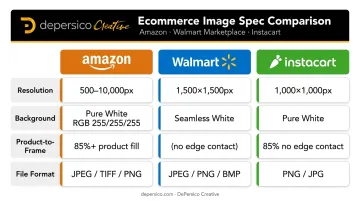
Sources: Amazon Seller Central; Walmart Marketplace; Instacart Docs
Trust, Compliance, and Label Legibility
In food and beverage, shoppers use product imagery to verify claims — non-GMO, organic, allergen-free — before buying. This is especially true online, where the image is the only way to inspect the label before purchase.
A blurry or poorly lit pack shot doesn't just look unprofessional. It can:
- Obscure mandatory label disclosures
- Misrepresent claims to buyers during line reviews
- Create compliance risk if outdated imagery shows claims the current label no longer carries
Retailers with strict clean-label standards — Whole Foods, Wegmans, MOM's Organic Market — apply strict ingredient-transparency scorecards. Any disconnect between submitted imagery and the physical label can stall or kill a placement.
Brand Differentiation and Equity
Compliance is the floor — brand equity is the ceiling. Once your imagery clears the retailer's technical requirements, it becomes an active selling tool.
According to a 2018 Ipsos survey of 2,002 U.S. adults, 72% said package design often influences their purchase decisions. In competitive F&B categories where dozens of SKUs compete side-by-side, color vividness, label sharpness, and overall appetite appeal directly determine whether a shopper picks up the product or moves on.
A professional pack shot library also carries weight in the sell-in process. Retail buyers typically review submitted imagery before they ever see — or taste — the product. Weak photography signals operational immaturity, and that impression is hard to recover from once the buyer moves on to the next brand.
What Makes an F&B Pack Shot Effective
Lighting for Food Appeal
Lighting in F&B pack shots serves two purposes at once: accurate product representation and appetite appeal. Diffused, even lighting eliminates harsh shadows that flatten packaging or make food look unappetizing. Controlled highlights allow glass bottles, metallic packaging, matte surfaces, and foil pouches to read correctly.
Common lighting mistakes that hurt food brands:
- Overhead-only lighting — creates flat, uninviting images with heavy bottom shadows
- Heavy directional shadows — obscures label text and makes packaging look darker than it is
- Uncontrolled reflections — particularly damaging on glossy packaging and glass bottles
Color Accuracy and Vibrancy
Nail the lighting, and the next challenge is color — because in food and beverage, color communicates before a shopper reads a single word. A 2023 peer-reviewed systematic review found that packaging color affects perceived healthfulness, with cool colors associated with greater health perceptions and white/transparent packaging carrying strong health associations. A separate study found that black packaging increased expected bitterness while pink and yellow increased expected sweetness — before any tasting occurred.
Color in a pack shot isn't decorative. It's sending flavor and value signals directly to the shopper's brain.
For brand standards, color drift across a SKU line is a serious problem. Even subtle white balance or exposure differences between sessions can make a flavor family look inconsistent on a retailer's shelf or product detail page. Maintaining cohesion requires:
- Consistent lighting setup across all sessions
- Calibrated monitor review during capture
- Color correction against approved Pantone or CMYK values in post-production
Angle Selection
A complete F&B pack shot set covers multiple angles, each serving a specific channel:
- Front-facing hero shot — mirrors how the shopper sees the product on-shelf; the primary ecommerce and retail image
- 45-degree or three-quarter angle — shows package depth and dimension; required by many retailers for planogram submissions
- Back panel shot — captures nutrition facts, ingredient list, and claims for compliance visibility and ecommerce listings
- Close-up detail shots — highlights key callouts like "Now with 20% more protein," a new flavor badge, or a certification logo
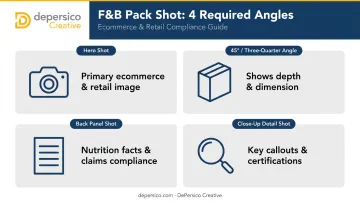
Brands that skip the back panel or detail shots often discover the gap when a retailer's online listing requires them — and a reshoot is the only fix.
Label Legibility and Key Callout Visibility
A pack shot that buries "gluten-free" or "no artificial flavors" in shadow — or angles the label so a key claim is partially hidden — wastes the most valuable real estate the brand has. Every element that drives trial must be sharp and legible at the image sizes used across all channels: brand name, product variant, net weight, and primary claims.
When those elements aren't visible, the pack shot doesn't just underperform. It actively works against the brand.
How the F&B Pack Shot Process Works
Pre-Production Planning
Pre-production is where most F&B pack shot projects succeed or fail. Before any photography begins, a shoot requires:
- Complete SKU list covering all flavors, sizes, and packaging formats
- Per-SKU shot list specifying angles, image count, and any supplementary shots
- Channel specifications for every platform: dimensions, resolution, and background requirements
- Brand style guide parameters including color standards, background choices, and typography visibility
Poor pre-production planning is the single biggest driver of reshoots and budget overruns in F&B pack shot projects. Discovering mid-project that Instacart requires a square crop or Amazon won't accept the chosen background color means starting over — which no brand with a launch deadline can afford.
Sample Preparation and Food Styling
Physical product samples must be shoot-ready before any lighting is set up:
- Labels must be clean, wrinkle-free, and correctly applied
- Flexible packaging must be filled or stuffed to represent natural shelf shape
- Bottles and cans must be free of smudges, dust, and condensation (unless condensation is intentional for visual appeal)
F&B pack shots sometimes incorporate minimal food styling — a sprinkle of fresh ingredients, an open package showing contents — to add appetite appeal without crossing into lifestyle territory. Studios with an in-house prep kitchen, like DePersico Creative's production space in West Chester, PA, let food brands prepare samples, style product, and shoot in one controlled environment — no external rental coordination required.
Capture and Quality Control
During the shoot, disciplined on-set process prevents the most expensive outcome: a reshoot.
- Camera and lighting setup is locked before the first SKU is shot and held consistent across every subsequent product
- Each product is photographed at all required angles per the pre-approved shot list
- Images are reviewed on a calibrated monitor before the set is struck — confirming sharpness, exposure, color accuracy, and label legibility at full resolution
That final monitor review is non-negotiable. In F&B — where seasonal packaging and limited-time-offer products run on tight deadlines — a focus issue or label shadow discovered after the set is struck means rebuilding everything from scratch.
Post-Production
Post-production for F&B pack shots involves several specific steps:
- Background removal and cleanup
- Color correction against brand-approved Pantone or CMYK values
- Removal of minor surface blemishes or label imperfections
- Cropping to channel-specific aspect ratios
- Export in required file formats (JPEG for web, TIFF for print, PNG for assets requiring transparency)
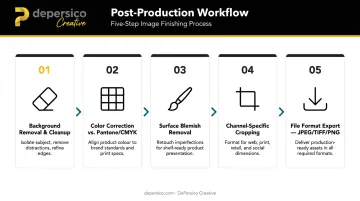
Post-production enhances accuracy — it doesn't change how the product actually looks. Over-retouching catches up with brands at the point of purchase: when the physical product doesn't match what the shopper saw online, trust erodes and returns climb.
Common Pack Shot Mistakes Food and Beverage Brands Make
Using Renders or Low-Quality Imagery
Many emerging F&B brands launch with packaging mockup renders or photos taken at the co-packer facility. Both consistently underperform against professional pack shots.
Amazon's official image guide explicitly prohibits graphics, illustrations, mockups, or placeholders as the main product image. Beyond platform rejection, buyers reviewing a sell-in deck or distributor catalog form an immediate impression of brand professionalism from the imagery. Low-quality photos signal operational immaturity — which can cost a brand a placement before the conversation even starts.
Shooting for One Channel Without Planning for Others
A brand shoots images optimized for their website. Then they apply to sell on Amazon and discover the images are too low-resolution. Each new channel surfaces a gap that wasn't planned for:
- Instacart requires a square format that wasn't captured
- A retailer's online catalog needs a back-panel shot that doesn't exist
- A foodservice sell sheet needs a lifestyle image no one thought to schedule
Every one of these situations requires a reshoot. A pre-production shot list that maps angles and technical requirements to each sales channel — built before the shoot date — eliminates the problem.
Neglecting to Update Pack Shots After Packaging Changes
Label updates happen constantly in food and beverage: new certifications, regulatory changes, seasonal packaging, brand refreshes. Every change requires updated photography.
Outdated imagery circulating across retailer PDPs, distributor catalogs, and brand websites creates three compounding problems:
- Consumer confusion — shoppers receive a product that looks different from the image they purchased from
- Trust erosion — claims shown in imagery that no longer appear on the physical label undermine credibility
- Compliance risk — misrepresentation of current label information can attract scrutiny from retailers and regulators alike
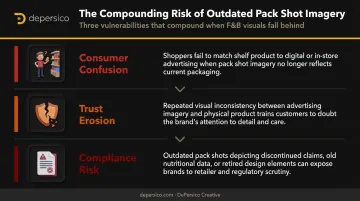
A pack shot library that lags behind the physical product creates real commercial exposure. Build the update process into the packaging change workflow — not as an afterthought once the new labels are already in distribution.
Frequently Asked Questions
How much does a product pack shot shoot cost?
Pack shot costs vary based on SKU count, shot types, studio setup, food styling complexity, and post-production scope. No authoritative F&B-specific benchmark exists publicly. Specialized food and beverage studios tend to cost less over time — stronger first results mean fewer reshoots.
What is the difference between a pack shot and lifestyle food photography?
A pack shot is a controlled, distraction-free image of the product on a neutral background, used for retailer submissions, ecommerce listings, and catalogs. Lifestyle photography places the product in a real-world setting to create emotional connection, and is primarily used in advertising campaigns and social media. Most brands need both, with pack shots taking priority as the foundation for retail and ecommerce channels.
How many pack shot images does a food or beverage brand need per product?
Plan for a minimum of three to four images per SKU: front hero, 45-degree angle, back panel, and at least one detail or supplementary shot. Brands selling across multiple channels with different image specifications may need additional crops and formats from the same shoot.
What background works best for food and beverage pack shots?
White or light neutral backgrounds are the industry standard for retail submissions and ecommerce platforms. Contextual or lightly styled surfaces can work for brand marketing assets. Consistency of background across all SKUs in a product line matters more than any single background choice.
Do food and beverage pack shots need to meet retailer or platform standards?
Yes. Amazon, Walmart, and Instacart each have specific requirements for resolution, background, product-to-frame ratio, and file format. A well-planned shoot should be spec'd to the most demanding platform requirements so images work across all channels without reformatting or reshooting.
How do I ensure color accuracy across all my product pack shots?
Color accuracy requires a calibrated monitor, consistent lighting across every SKU, and post-production correction against approved Pantone or CMYK values. Shooting all SKUs in a single session is the most reliable approach — even minor ambient light shifts between sessions create visible inconsistency across a product line.