Introduction
Walk the cereal aisle of any grocery store and you'll see the same dynamic play out hundreds of times per hour: a shopper's eyes scan the shelf, pause for a fraction of a second, and either stop or move on. That pause — or the absence of it — is often determined by a product name.
Most food and beverage founders treat naming as a creative exercise: brainstorm some options, pick the one the team likes, move on. That instinct is expensive.
A product name is one of the earliest and most permanent strategic decisions a brand makes. It shapes how retail buyers perceive the product, how distributors pitch it, and whether a shopper gives it a second look after the first.
Food and beverage naming carries its own category of challenges. The name has to evoke appetite, communicate identity, fit on a 3-inch package face, and leave room for the product line to grow — all at once. This guide covers naming strategy frameworks, competitive shelf analysis, and trademark timing so you can make that decision with confidence.
Key Takeaways
- 76% of grocery purchase decisions are made in-store (per POPAI research), making shelf-level naming critical
- Strong names layer sensory cues with emotional or occasion signals — not just ingredient lists
- Choose your naming strategy type — emotional, descriptive, or metaphorical — before brainstorming begins
- Competitive shelf audits reveal oversaturated naming territories — and the white space worth owning
- Trademark registration before packaging investment is non-negotiable in the saturated F&B category
Why Product Naming Determines Shelf Success in Food and Beverage
According to POPAI's 2012 Grocery Channel Study, 76% of purchase decisions happen in-store. The shopper didn't arrive with your product on their list. They found it — or didn't — based on what the shelf presented in those few seconds of scanning.
That makes the product name a front-line selling tool, not a label.
What a Name Must Do Before the Shopper Reads Anything Else
Consider two side-by-side options in the rice aisle: Seasoned Rice Mix versus Fire-Roasted Spanish Rice. Both describe the same product category. Only one communicates quality, flavor, and an eating experience before the shopper reads a single word of back-panel copy.
The second name does something the first cannot: it creates appetite. And appetite is the primary driver of impulse purchase in grocery.
A strong product name also compounds across the brand lifecycle:
- Drives word-of-mouth — consumers repeat names they can say and remember
- Aids repeat purchase — shelf recognition accelerates when the name is distinctive
- Supports line extensions — a well-constructed name creates a naming architecture with room to grow
Why You Can't Pivot After Launch
In SaaS, a product rename is an afternoon's work and a redirect. In food and beverage, it triggers barcode changes, retail transition planning, and packaging write-offs. The GS1 GTIN Management Standard requires a new GTIN whenever a primary brand name changes. That means every item record, barcode, and retail system entry tied to that product must be updated across the supply chain.
Real examples: Aunt Jemima became Pearl Milling Company, Uncle Ben's became Ben's Original, Eskimo Pie became Edy's Pie. Each transition required years of planning and significant operational investment. The lesson is consistent: getting the name right before launch costs a fraction of fixing it after. At DePersico Creative, packaging — including every word on it — is treated as the brand's primary selling tool, which is why naming and packaging strategy are developed together from the start.
Naming Strategies That Work for Food and Beverage Products
Before any brainstorm, choose a naming strategy. The strategy determines which creative directions are worth exploring and which will pull the brand off course. Here are four approaches that consistently perform in food and beverage:
Emotional and Experiential Naming
Emotional names connect consumers to how a product will make them feel — before they taste it. Grandma's Cornbread Mix triggers nostalgia. Sunday Morning Pancakes references a ritual. These names transport the shopper to a moment rather than describing an ingredient.
This approach works well for:
- Comfort food and baked goods
- Premium and indulgent snack categories
- Beverages tied to occasions or lifestyles
Descriptive Plus Naming
Purely literal names (Baked Potato Chips) are forgettable. Purely abstract names confuse shoppers who don't know what they're buying. Descriptive Plus finds the productive middle ground: anchor in what the product is, then layer in a differentiating quality.
Slow-Smoked Mesquite Almonds names the ingredient and the method. It tells you what you're getting and signals a premium preparation that justifies a higher price point. Flavored Almonds does none of that.
Metaphorical and Suggestive Naming
Metaphorical names communicate a benefit or feeling without stating it directly. Liquid Death — canned water with $263M in 2023 retail sales — doesn't describe water at all. It sells attitude and irreverence to an audience that rejects conventional wellness marketing.
The trade-off: metaphorical names require packaging and visual identity to carry the meaning the name implies. Without strong design support, the name reads as random rather than evocative.
Alliterative and Playful Naming
Alliterative names (Poppin' Pita, Crunchy Critters) are easier to remember and tend to feel approachable — which suits snack foods, children's products, and casual meal brands. The phonetic repetition creates a memorability hook that pure descriptive names lack.
Use this strategy carefully in premium categories. Playful construction can undermine a positioning built on quality or sophistication.
The Language of Craving: Using Words That Drive Purchase
In food and beverage, word choice is not a copywriting exercise. It's a purchase-influencing decision.
Research on sensory language in food contexts consistently shows that descriptors tied to taste, texture, temperature, and aroma shape how consumers perceive a product before consumption. Studies on food-label language show that sensory labels can affect taste acceptance — meaning the name primes the experience.
Functional Language vs. Appetite-Forward Language
The distinction matters more than most brands realize:
| Functional | Appetite-Forward |
|---|---|
| High-Protein Breakfast Bar | Toasted Almond Crunch Bar |
| Low-Fat Chips | Lightly Salted Sea Salt Crisps |
| Whole Grain Cereal | Honey-Toasted Grain Clusters |
| Pasta Sauce | Slow-Simmered Garden Tomato Sauce |
The left column describes a feature. The right column creates a craving. The best food names layer sensory cues — texture, heat, freshness — with an occasion or benefit signal to produce a craving before the shopper even reads the label.

How Phonetics Affect Perception
Word sounds carry meaning independent of word definitions. Peer-reviewed research on sound symbolism in food names shows that speech sounds produce systematic expectations about food properties — hardness, sweetness, freshness, even healthiness.
| Sound Type | Examples | Perceived Quality |
|---|---|---|
| Hard consonants | K, T, hard C | Bold, energetic, crunchy |
| Soft consonants | M, L, S | Smooth, gentle, premium |
This doesn't mean engineering a name phonetically from scratch. It means being deliberate about final candidates rather than defaulting to whatever sounds fun internally.
One principle runs through every naming project DePersico Creative works on: the name and the package are a single system. Font, color, food photography, and product copy either reinforce what the name promises or contradict it.
A name like Hand-Picked Heirloom Salsa creates an expectation of authenticity and craft. Put that name on generic packaging with flat photography and the promise collapses immediately. Strong naming and weak packaging don't split the difference — the weaker element pulls the whole impression down.
How to Build Your Food Product Naming Process Step by Step
Most naming failures happen before the brainstorm starts. The process below addresses that gap.
Step 1 — Define Your Foundation
Before generating a single name candidate, answer these questions in writing:
- Who is your target consumer, specifically? (Not "adults 25–54" — a real person with real habits)
- What is the product's single most compelling differentiator versus the top three competitors?
- What emotional or functional territory do you want to own on the shelf?
Naming sessions without this foundation produce generic output. Treat the brief as the work itself — skip it and you're paying for guessing, not strategy.
Step 2 — Audit the Competitive Shelf
Walk the actual grocery category. Photograph the shelf. Map how every competitor names their products, and look for:
- Overused words: If every brand in your category uses "harvest," "natural," or "artisan," those words are invisible noise — not differentiators
- Visual naming patterns: Do competitors lead with flavor, brand name, or occasion? Which approach stands out?
- White space: The naming territory no competitor is currently occupying
DePersico Creative's SWIFI process (Strengths, Weaknesses, and Ideas for Improvement) is built around exactly this kind of competitive shelf intelligence. DePersico evaluates every name candidate against four filters derived from that research: relevance, uniqueness, simplicity, and memorability.
Step 3 — Generate Broadly, Then Filter Strategically
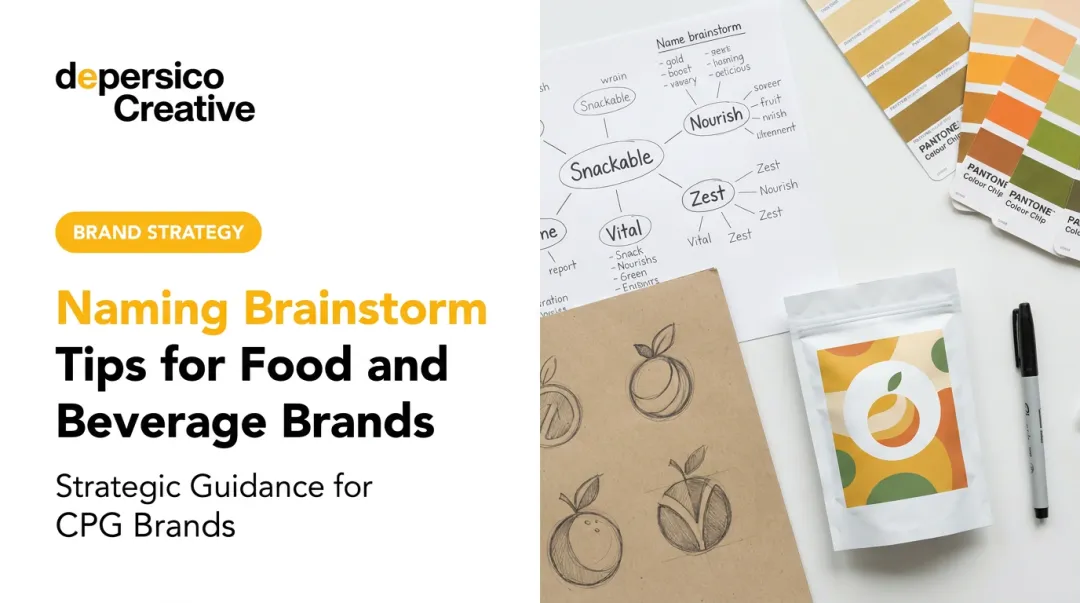
Run brainstorms across multiple strategy types: emotional, descriptive, metaphorical, alliterative. Filter only after you've exhausted the field — the strongest candidates rarely surface first.
Filter candidates against these practical criteria:
- Does it fit on the package at the required type size?
- Is it easy to say and spell on first encounter?
- Does it scale to potential line extensions without becoming awkward?
- Does it create appetite appeal or emotional resonance with your specific target consumer?
- Has it cleared a preliminary trademark search in the relevant Nice Classification?

Common Food Product Naming Mistakes to Avoid
Naming for the Internal Team, Not the Consumer
The most common — and most costly — naming mistake is choosing a name the team loves but consumers don't recognize. Internal context creates internal bias. A name that references your founder's hometown or a clever industry pun may land perfectly in a conference room and fall flat in a grocery aisle.
Seek feedback early from real people in your target consumer segment. Before any packaging investment, informal validation from actual shoppers is the cheapest course correction available.
Choosing a Name That Limits Scalability
A hyper-specific name (Mango Habanero Summer Sauce) can work for a hero product. It becomes a liability when you try to extend the line into a winter variety, a mild version, or an entirely different flavor profile.
The name for your lead product is also the foundation for your product family. Build naming architecture into that decision before you commit to packaging — not after.
Skipping Legal Due Diligence
The food and beverage category spans USPTO trademark Classes 29, 30, and 32 — covering processed meats, dairy, coffee, condiments, and non-alcoholic beverages. These are among the most heavily filed trademark classes in the US, meaning a name that feels original may already be registered in an adjacent food category.
Skipping this step has real consequences:
- Printed packaging becomes unusable if a conflict surfaces after launch
- Pitched buyers lose confidence when a rebrand disrupts the relationship
- Sales sheets, trade show materials, and digital assets all require replacement
- Full rebrands cost significantly more than an early trademark search
Conduct trademark searches and consult an IP attorney before committing to any name — well before production or retailer outreach begins.
How to Test and Validate Your Food Product Name
Internal debate is not a validation method. Neither is asking friends and family.
Structured Naming Research
A basic naming validation study presents 3–6 name candidates alongside a product description or image, then measures:
- Which name consumers choose when asked directly (preference)
- Emotional and appetite response to each name (appeal)
- Which names consumers recall without prompting (memorability)
- How likely they are to buy a product with this name (purchase intent)
- What negative or off-target meanings each name triggers (unintended associations)
That last measure is often the most valuable. Names that test beautifully on the first four metrics occasionally carry regional slang meanings or cultural associations that the team never anticipated.

Shelf Simulation: The Real Test
A name that performs well in a spreadsheet may disappear entirely on a real shelf. Mock up the name in its packaging context, then assess:
- How does it read at 8–10 feet of shelf distance?
- Does it hold up visually next to the three closest competitors?
- Does the name integrate with the font, color system, and photography — or fight against them?
These aren't questions a naming spreadsheet can answer. DePersico Creative applies their SWIFI process — a visual perception framework developed over 45 years working with brands like Kellogg's, Campbell's, and McCormick — to evaluate how a name actually performs in full packaging context, before a single package goes to print.
Frequently Asked Questions
What makes a food product name successful on the grocery shelf?
A successful name communicates category and identity quickly, creates appetite or emotional appeal, and is easy to remember and say — all while working cohesively with the packaging design.
Should a food product name describe the flavor or the feeling it delivers?
The strongest names do both. They anchor in a sensory cue — an ingredient, texture, or flavor — while suggesting an experience or occasion.
How do I name a food product line extension without confusing my customers?
Use a consistent naming architecture — a shared prefix, suffix, or flavor descriptor system — that makes the family relationship immediately recognizable. Shoppers should see the connection to the parent product before they read the distinguishing detail.
How long should a food product name be?
One to three words is the practical range for most retail food products. Shorter names are more memorable, but a two-word combination often carries more meaning and differentiation than a single generic word can manage on its own.
Do I need to trademark my food product name?
Yes — before packaging, retail presentations, or marketing investment. The food and beverage category is heavily name-saturated, and an unregistered name can force a costly rebrand when a conflict emerges after launch.
How do I know if my food product name will resonate with my target consumer?
Test it with real consumers through structured naming research. Present candidates alongside product imagery, measure preference and purchase intent, and probe for unintended negative associations.