Introduction
NielsenIQ research found that shoppers notice only 15 of 450 point-of-sale materials in a typical store visit. Your packaging imagery has a fraction of a second to earn attention — and most of the time, it doesn't.
The problem? Most brands treat food photography as a creative afterthought rather than a strategic tool. They hire photographers whose work looks gorgeous in a magazine but falls completely flat on a retail shelf or e-commerce thumbnail.
CPG food photography is a distinct discipline. It demands technical precision, cross-channel thinking, and an understanding of how packaging visuals perform in environments that have nothing to do with aesthetics: a Walmart shelf at eye level, a mobile product listing on Instacart, a frozen food freezer door.
This guide covers what separates CPG food photography from other niches, five photographers and studios with documented brand experience, and the criteria that matter when hiring.
Key Takeaways
- CPG food photography serves packaging, retail, and e-commerce — not restaurant menus or cookbooks.
- The best studios pair technical precision with full production coordination — stylists, retouchers, and motion capabilities included.
- Pricing varies widely by scope — get itemized bids comparing identical deliverables.
- Usage rights for packaging differ from editorial licensing; clarify terms before signing.
- Agencies that handle both photography and packaging design eliminate visual disconnect at launch.
What Makes CPG Food Photography Different
A food photo that wins a James Beard Award for best cookbook probably won't sell frozen dinners at Kroger. The skills that produce gorgeous editorial spreads (dramatic lighting, imperfect textures, narrative scene-setting) often work against CPG packaging, where the image must communicate flavor, portion, and quality in less than two seconds from three feet away.
The Technical Demands Are Specific
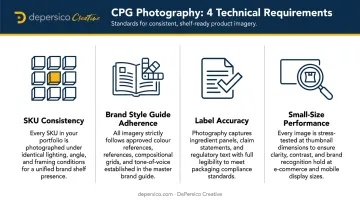
CPG photography has requirements that most editorial or restaurant photographers simply don't train for:
- Consistency across SKUs: A six-flavor product line needs cohesive images shot across days or weeks without visible variation
- Brand style guide adherence: Color temperature, shadow depth, and angles are often locked in before the shoot begins
- Label accuracy: Under 21 USC 343(a)(1), packaging imagery cannot misrepresent the product — what's shown must reflect what's inside
- Small-size performance: Hero shots must hold up at 1.5 inches on a thumbnail and at full bleed on a club store carton
The Channels Keep Expanding
NIQ reported in 2024 that 72% of products fail to describe themselves completely online, which points to a real production gap. A single hero shot no longer covers the brief.
GS1's 2023 retail-grocery guidance defines eight distinct image types: primary pack, mobile-ready hero, content/texture, detail, application, ambience, montage, and size comparison. Each serves a different channel and purchase context.
A CPG photographer who can only deliver a clean hero shot leaves the rest of that brief unfilled.
Top Food Photographers for CPG and Food Brands
These photographers and studios were selected based on documented commercial and CPG client experience, verifiable brand portfolios, and capabilities suited to retail and e-commerce food brand work.
Jeff Schear Visuals — Chicago, IL
Jeff Schear operates as both photographer and producer — he assembles and coordinates the full specialist crew, including food stylists, prop stylists, digital technicians, and retouchers. This producer-photographer model matters for CPG work: it means one point of accountability for a shoot that involves multiple moving parts.
His Kraft Heinz relationship is one of the clearest documented cases of CPG production at scale — spanning packaging, advertising, recipe content, and R&D imagery across multiple sub-brands.
| Attribute | Details |
|---|---|
| Specialty Focus | Packaging hero shots, advertising campaigns, recipe content, R&D imagery, multi-SKU product lines |
| Notable CPG Clients | Kraft Heinz, Halo Top, Blue Bunny (with sub-brands including Philadelphia, Lunchables, Cool Whip, Shake 'N Bake) |
| Photography Style | Lifestyle-oriented commercial food imagery; adapts across bold advertising and studio-controlled product shots |
Judy Doherty Photography — Southern California
Judy Doherty's studio focuses specifically on CPG and food brand content — the site explicitly positions around packaged goods, not restaurants or editorial. Clients include national and regional brands across grocery, club, and e-commerce channels.
What distinguishes her operation for CPG brands is the range of deliverable formats: stills, stop motion, GIFs, reels, and video are all in-house. For brands building content libraries across Amazon, Costco, and social simultaneously, that range cuts production time significantly.
| Attribute | Details |
|---|---|
| Specialty Focus | CPG product close-ups, Amazon and club store e-commerce assets, lifestyle advertising, multi-format content libraries |
| Notable CPG Clients | Pacific Foods, Noosa, Milton's, Pure Protein |
| Photography Style | Creative lighting with hard shadows and color blocking; real-world lifestyle scenes; adapts to brand aesthetics |
OMS Photo — Cincinnati, OH and Denver, CO
OMS Photo has been operating for over 35 years with 18 in-house employees across two studio locations. The infrastructure here is meaningful: integrated retouching and video production under the same roof as commercial food photography means fewer handoffs between production stages.
Their client work spans food hero shots, retail-ready packaging imagery, and e-commerce product photography — with documented work for Honey Stinger and UDF Quakes in their case studies.
| Attribute | Details |
|---|---|
| Specialty Focus | Advertising photography, retail packaging, e-commerce product imagery, food hero shots |
| Notable CPG Clients | Honey Stinger, UDF Quakes |
| Photography Style | Polished, high-resolution, detail-led commercial imagery; suited for retail and digital shelf contexts |
Teri Studios — Cincinnati, OH
Teri Studios has decades of commercial food photography experience, with a roster that has included Conagra Brands, Kellogg's, and Kraft Heinz through various production directory listings. They now combine traditional photographic expertise with AI-assisted image creation.
If the brief includes packaging-bound imagery, clarify upfront which assets are camera-made versus AI-generated or composited. Packaging requires documented provenance and label accuracy — something worth addressing in the contract before production begins.
| Attribute | Details |
|---|---|
| Specialty Focus | Food imagery for packaging and advertising; AI-assisted concept and image development |
| Notable CPG Clients | Conagra Brands, Kellogg's, Kraft Heinz |
| Photography Style | Craft-led commercial food imagery; currently integrating AI into production workflow |
DePersico Creative — West Chester, PA
DePersico Creative is a full-service food and beverage branding agency with an in-house food photography studio and prep kitchen operating since 1977. With over 45 years serving national CPG brands — including Kellogg's, Campbell's, and McCormick — their model differs from standalone photographers in one critical way.
Photography is produced alongside packaging design, brand strategy, and creative linguistics as a single integrated process.
Their internal positioning frames it directly: "To us… PHOTOGRAPHY IS DESIGN." When the same team developing your packaging is also producing the hero food shot that goes on that package, there is no briefing gap between the two — the image is built to serve the brand system it lives inside, not adapted to fit afterward. During product launches and brand refreshes, that alignment eliminates one of the most common and expensive production problems CPG teams face.
| Attribute | Details |
|---|---|
| Specialty Focus | Integrated CPG food photography produced in-house alongside packaging design and brand strategy — not a standalone photography service |
| Notable CPG Clients | Kellogg's, Campbell's, McCormick, Ball Park, Idahoan, Sea Best |
| Photography Style | Appetite-driven, shelf-optimized imagery designed to trigger purchase intent; appetite appeal and visual hierarchy are treated as design decisions, not photographic afterthoughts |

What to Look for When Hiring a CPG Food Photographer
The most common mistake brands make: selecting a photographer based on portfolio aesthetics alone. A beautiful set of restaurant plating shots or a moody cookbook spread tells you almost nothing about whether a photographer can deliver consistent, shelf-ready imagery for a six-SKU frozen entrée line. Hiring on aesthetics without checking CPG fit leads to re-shoots, off-brand packaging, and avoidable delays.
1. Documented CPG or Commercial Brand Experience
Look specifically for:
- Product packaging shots in the portfolio (not just food on plates)
- Multi-SKU campaigns showing consistency across flavors or varieties
- Named grocery or retail brand clients — not restaurant groups or food media
- Any documented work with national or regional CPG companies
2. Studio Infrastructure and Food Styling Access
CPG shoots need controlled environments. Ask directly:
- Is there an in-house studio, or is one rented per project?
- Is food styling in-house, or contracted out per shoot?
- Is there an on-site prep kitchen for ingredient preparation and product testing?
Outsourced styling adds coordination risk. Studios with integrated food stylists (or agencies like DePersico Creative with dedicated in-house facilities) cut the number of handoffs between brief and final image, which is where scope creep and miscommunication typically enter.
3. Usage Rights and Licensing Scope
ASMP's licensing framework is explicit: delivering image files does not transfer copyright or commercial usage rights. For CPG brands, this distinction is financially significant — packaging images may be in circulation for three to five years across multiple retail, e-commerce, and advertising contexts.
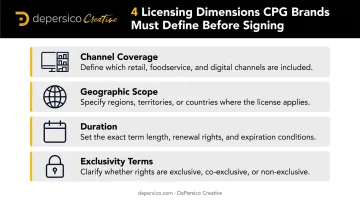
Before signing, define:
- Which channels are covered — packaging, POS, retailer product pages, paid media, and social each need to be named explicitly
- Geographic scope — regional, national, or global
- Duration — whether rights are time-limited or perpetual
- Exclusivity terms — category-exclusive or open license
A vague "digital use" clause will not cover Amazon retail media, Instacart syndication, or Walmart.com listings without negotiation.
4. Alignment with Brand Strategy
A CPG photographer who understands retail context and consumer positioning will make different choices than one focused purely on composition. The question isn't whether the image looks good — it's whether it works on the shelf, the product page, and the sell sheet simultaneously.
Integrated agencies hold a structural advantage here. When photography is developed alongside packaging design and brand strategy, the image is built for the brand from the start rather than retrofitted after the package is already designed.
Conclusion
Choosing a food photographer for a CPG brand is a procurement decision with downstream consequences. The wrong choice produces imagery that looks appealing in isolation but doesn't drive trial on shelf, doesn't scale across a product line, and may require expensive re-shoots before a retail launch.
Evaluate photographers on CPG track record and studio capabilities — and specifically on how their workflow connects to your packaging and brand process, not just which portfolio images catch your eye.
If your brand needs photography built from the ground up alongside packaging strategy, DePersico Creative offers in-house food photography as part of a complete food brand design process. Reach out to discuss how integrated photography and packaging design can strengthen shelf appeal and move more product from launch day forward.
Frequently Asked Questions
How much does it cost to hire a food photographer for a CPG shoot?
Professional CPG food photography shoots typically range from $2,000 to $10,000+, depending on the number of SKUs, food styling requirements, studio, props, and usage licensing. CPG shoots cost more than restaurant photography because they involve broader licensing scope and more complex production. Request itemized bids that separate creative fees, styling, and usage rights.
What is CPG food photography?
CPG food photography produces images specifically for consumer packaged goods — packaging, retail displays, e-commerce listings, and advertising — rather than editorial or restaurant contexts. Unlike restaurant photography, CPG work demands consistency across product lines, label accuracy, and performance across both print and digital formats.
What's the difference between a restaurant food photographer and a CPG food photographer?
Restaurant photography prioritizes mood and ambience for a single-use context. CPG photography requires consistency across SKUs, studio-controlled environments, brand style guide adherence, and images that perform across packaging, e-commerce, and paid advertising simultaneously.
Do I need a food stylist in addition to a food photographer for a CPG shoot?
Yes, nearly always. Food stylists ensure the product looks exactly as described on the label, meets brand standards, and photographs accurately across hero shots and variants. Some photographers coordinate styling independently; integrated agencies like DePersico Creative include styling as part of their in-house process.
How do I evaluate a food photographer's portfolio for CPG suitability?
Look specifically for packaged goods, product-on-white, or retail campaign imagery — not just restaurant plates or editorial spreads. Ask about their experience with multi-SKU shoots, brand style guide adherence, and whether they have handled both packaging and e-commerce deliverables for a single client.
How many images should I expect from a CPG food photography shoot?
Deliverable counts vary by brief and budget. GS1's retail-grocery taxonomy identifies eight distinct image types per SKU — from primary hero shots to ambience images. Define the full shot list by SKU and channel before the shoot begins, and confirm it in the project contract.