Introduction
Walk into any grocery store and run your eyes across a refrigerated case or snack aisle. You'll make dozens of micro-judgments in seconds — reaching for one product, ignoring the next — without knowing why. That split-second reaction is branding doing its job. Or failing to.
For food and beverage startup founders, this is the core problem. According to NielsenIQ, 90% of CPG packaging redesigns fail to create meaningful sales impact — not because the products are inferior, but because the brand fails to connect before the shopper moves on.
That failure isn't a design problem — it's a strategy problem. This guide covers a practical, F&B-specific branding framework: how to define your identity, articulate what makes your product worth picking up, build a visual system that earns shelf attention, and avoid the costly mistakes that push founders into expensive rebrands later.
F&B branding isn't generic startup branding with a food label slapped on. The shelf is your pitch meeting, your website, and your sales team — all compressed into a package that gets roughly five seconds of consideration.
Key Takeaways:
- Define your target shopper's emotional motivation before touching any design
- Your unique value proposition must survive a three-second shelf test
- Packaging is your primary sales tool — treat it like one
- Visual identity errors compound into expensive rebrands; invest in strategy first
- Brand voice must stay consistent across every touchpoint, from packaging to buyer decks
Why Branding Strategy Hits Different in Food and Beverage
Most F&B founders pour their early resources into product development, sourcing, compliance, and logistics. Branding gets treated as the thing you do when everything else is figured out. That sequencing is exactly backwards.
The Sea of Sameness Problem
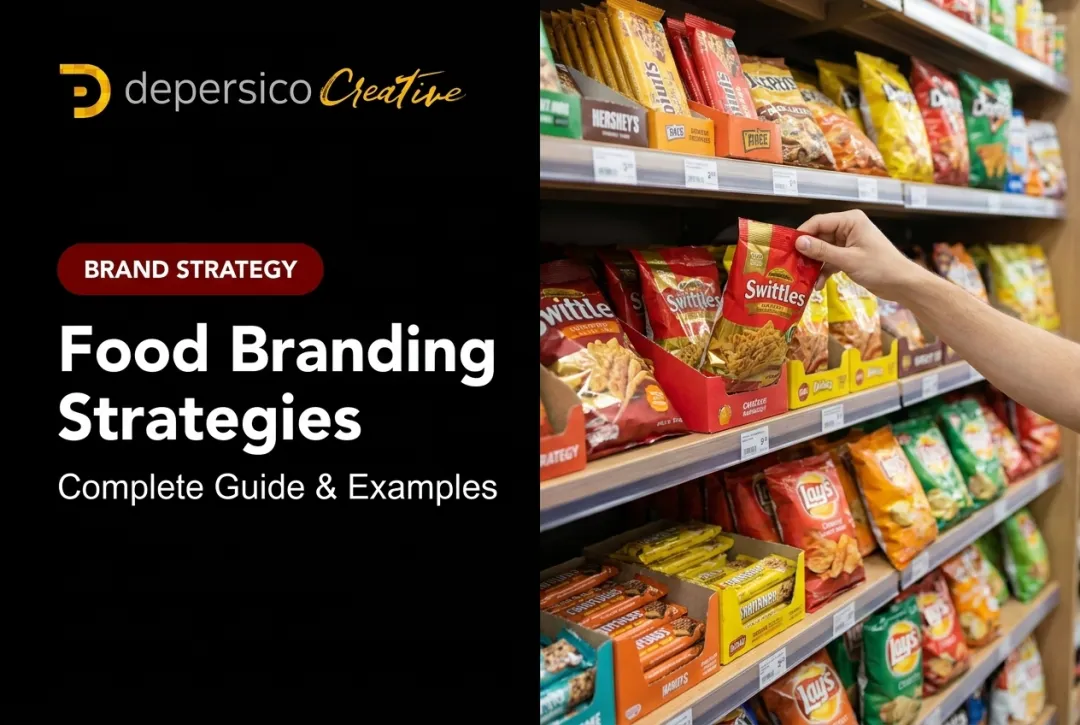
Grocery shelves are brutal environments for undifferentiated products. A typical snack or beverage category might have 40+ SKUs competing for attention within a three-foot section. Private-label products have improved dramatically in quality and presentation. And shoppers — already pressed for time — have become more skeptical of vague claims.
An unanchored brand doesn't just underperform. It disappears.
The 2024 IFIC Food & Health Survey of 3,000 US adults found that purchase decisions are driven by:
| Purchase Driver | % Rating "Very Impactful" |
|---|---|
| Taste | 85% |
| Price | 76% |
| Healthfulness | 62% |
| Convenience | 57% |

These aren't rational deliberations — they're emotional snap judgments. If your packaging doesn't immediately signal the right cues for each driver your product competes on, you've already lost the sale. That's exactly what brand strategy is built to solve — before a dollar of marketing gets spent.
Brand Strategy vs. Marketing: A Critical Distinction
Brand strategy defines what your product stands for and who it's for. Marketing spends money communicating that. Funding marketing before brand strategy is set is one of the most common and expensive mistakes F&B founders make.
Strong brand positioning delivers concrete business advantages beyond the shelf:
- Retail buyers assess category fit and brand readiness visually — often before tasting anything
- Clear positioning justifies price premiums that vague branding can't sustain
- NielsenIQ's analysis of small CPG brands found that those targeting narrow premium audiences achieved repeat rates in the top 25% of their categories
A misaligned brand strategy doesn't just underperform in market — it actively undermines every media dollar spent on top of it.
Step 1: Define What Makes Your F&B Brand Uniquely Different
Identify Your Target Shopper, Not Just Your Target Market
Demographics don't buy products. People with specific beliefs, habits, and emotional motivations do.
One of the most practical frameworks for this is Clayton Christensen's Jobs to Be Done — the idea that consumers "hire" a product to accomplish something specific in their lives. In his foundational milkshake study, 40% of milkshakes were purchased early in the morning, not as dessert treats, but as commute companions that staved off hunger. The product was competing with bagels and bananas, not other milkshakes.
That kind of behavioral insight changes everything downstream — from the product name to the packaging color to the copy on the back panel.
Ask about your target shopper:
- What do they believe about food and what they put in their body?
- What emotional job does this product perform — comfort, convenience, status, health, indulgence?
- What does choosing your product signal about them to others?
A mom grabbing fast weeknight dinner solutions and a performance-focused athlete scanning ingredient lists are motivated by completely different emotional cues, even if they shop the same aisle. Understanding that gap is what makes your positioning sharp enough to act on.
Clarify Your Brand's Unique Value Proposition
A useful UVP structure: "Only [Brand] delivers [specific benefit] for [target shopper] because [credible reason to believe]."
The trap most F&B brands fall into is stopping at generic claims — "natural," "delicious," "premium." Those words appear on thousands of competing labels and register as noise.
Your UVP must survive a three-second shelf test: if the core promise can't be communicated instantly through visual and copy cues, it isn't clear enough.
DePersico Creative's process anchors this work around four questions a shopper subconsciously asks at the shelf:
- What is this product used for?
- What will I experience when I use it?
- What do I want from this category?
- What does this product offer that competitors don't?
The fourth question is where the real positioning lives. When DePersico worked with J. Skinner Baking — a wholesale bakery with no retail consumer positioning — the sharpened UVP centered on artisanal authenticity: "100 layers of authentic Danish," with a see-through package panel letting the product speak visually. The result was 210–340% sales growth following the rebrand.

Define Your Brand Promise and Positioning
These aren't interchangeable:
- Brand promise: The commitment made to the consumer — what they can always expect from your product
- Positioning statement: How your brand is defined relative to competitors and the category
A hot sauce brand promising "bold flavor for adventurous cooks" occupies a specific, ownable position. "Great taste" owns nothing — every competing SKU on that shelf makes the same claim. Write both statements before any design work begins. Every creative decision that follows — naming, color, typography, copy — should be testable against them.
Step 2: Build a Visual Identity That Commands Attention at Retail
In food and beverage, visual identity is the brand experience for most shoppers. There's no sales conversation, no demo, no website visit. The package faces a stranger for three seconds and either earns their attention or loses it. The visual system carries everything.
Name, Logo, and Color: The First Story Your Brand Tells
Brand naming in F&B is a strategic decision, not just a creative one. A strong name should be:
- Memorable and easy to pronounce
- Available for trademark registration
- Evocative of the product's promise or personality
- Scalable beyond a single product, flavor, or geography
Naming a brand after one flavor or a hyper-specific regional reference creates a ceiling. The name that feels charming on your first SKU can become an obstacle when you're pitching a line extension to a retail buyer.
Color carries enormous psychological weight on shelf. A controlled experiment on organic pasta packaging found that black packaging produced the highest willingness to pay, while green generated the highest trust and sustainability ratings — results that cut against what many brands assume. Color choices must also account for the category context: what surrounding SKUs look like shapes whether your package stands out or blends in.
Your logo and color system should hold up at small sizes, in uneven store lighting, and in smartphone photos taken by consumers. Those same elements feed directly into the next layer of your visual system: typography and photography.
Typography, Photography, and the Supporting Visual System
Typography communicates brand personality before a single word is consciously read:
- Hand-lettered fonts signal artisan, craft, and small-batch quality
- Clean sans-serifs read as modern, functional, and straightforward
- Bold serifs project heritage, authority, and trust

Type choices must also meet FDA label legibility requirements — including minimum type size based on package dimensions (at least 1/16 inch for small packages) and contrast requirements that make mandatory information readable in actual retail conditions.
Food photography is one of the most underutilized brand assets available to F&B startups. When DePersico Creative worked with Idahoan Foods on the "Fully Loaded" product line, bold appetite-forward photography drove measurable lift in shopper trial rates — proof that how the food looks on-pack directly shapes whether a shopper reaches for it.
Professional food imagery tells shoppers the product inside is worth the price on the tag. Generic stock photography tells them the opposite.
Step 3: Make Packaging Your Most Powerful Brand Asset
Packaging is a salesperson working every hour the store is open — no commissions, no scripts, and according to NielsenIQ shelf research, roughly 19 seconds to close the sale before a shopper moves on.
What Packaging Must Do Simultaneously
Strong F&B packaging performs multiple jobs at once:
- Stands out against adjacent SKUs in real shelf conditions, not just in a design mockup
- Delivers the right emotional cues within the first few seconds of visual contact
- Meets FDA requirements: nutrition labels, claim compliance, net quantity placement
- Triggers craving, trust, or curiosity that converts a browser into a buyer
The Role of Visual Perception Assessment
One of the most common and costly packaging mistakes is evaluating a design in isolation — on screen, in a PDF, or in a boardroom — rather than in the shelf environment where it actually has to perform.
DePersico Creative's SWIFI (Strengths, Weaknesses, and Ideas For Improvement) process closes this gap by evaluating how a package actually functions in its competitive context — not as a standalone design artifact. The audit examines:
- Shelf adjacencies and how the package reads against neighboring SKUs
- Lighting conditions in actual retail environments
- Information hierarchy and what the eye catches first
- The specific visual cues that prompt a shopper to reach — or keep walking
The DaVinci pasta case is instructive here. After five consecutive years of declining sales, DePersico applied competitive analysis and UVP sharpening to make the brand visually and messaging-wise distinct from category leaders — a repositioning that began with understanding exactly where the original packaging was losing shoppers.
Creative Linguistics: Words That Work as Hard as Design
The specific language on packaging is as strategically important as the visual design, and it receives far less attention from most founders.
"Slow-simmered" does different work than "cooked." "Sun-ripened" triggers different associations than "fresh." These word choices create appetite appeal and emotional resonance that generic descriptors simply can't.
DePersico Creative's approach to Creative Linguistics — developed specifically for the F&B context — focuses on identifying the words and phrases that quickly create either an emotional or logical connection with the product. This spans product positioning lines, flavor callouts, benefit claims, and back-panel brand stories.

FDA and FTC regulations govern exactly what packaging copy can and cannot say: nutrient content claims, health claims, and structure/function claims each carry specific requirements. Copy that makes unsubstantiated claims creates real regulatory exposure. Strong creative linguistics works within those rules while still driving trial.
Step 4: Craft Your Brand Voice and Messaging for F&B Audiences
Brand voice extends beyond packaging to every surface where a consumer or buyer encounters your brand: website, social content, e-commerce listings, sell sheets, and retail buyer pitch decks.
Defining Voice Attributes
Start by identifying three to five voice attributes that feel genuinely true to your brand — not aspirational, but accurate. Examples: "warm, direct, and a little irreverent." Or "knowledgeable, confident, and approachable."
These attributes become the filter for every piece of copy your brand produces. A brand that is playful and casual on Instagram should feel like the same brand in a buyer presentation — more professional in tone, but unmistakably consistent in personality.
Storytelling as Differentiator
F&B brands have a structural storytelling advantage that most founders underuse. In a category where authentic brands consistently outperform generic equivalents with similar product quality, your narrative is a genuine differentiator. Common story assets include:
- The founder's obsession with a recipe or ingredient
- A sourcing philosophy tied to a specific region or producer
- A family tradition that inspired the product
- A problem the founder personally needed to solve
DePersico's work with DaVinci pasta demonstrates the format: a back-of-pack brand story emphasizing Italian culinary heritage and distinctive production process, extended through simple recipes that deepened the consumer relationship. The storytelling wasn't decorative — it carried the brand's unique value proposition.
For startups, the goal is a brand story you can tell in one sentence. If you can't do that, the story isn't clear enough yet.
Common Branding Mistakes F&B Startups Must Avoid
The most costly branding mistakes in food and beverage are predictable — and preventable.
Four patterns show up repeatedly across failed launches:
- Designing for yourself, not your shopper. Packaging founders personally love often speaks to no one in particular. The shelf isn't your living room wall.
- Mimicking the category leader. Copying a dominant brand's color palette or layout gets the new product confused for a knockoff — or ignored entirely. Use visual distinctiveness deliberately to break one category convention.
- Inconsistent branding across SKUs. Varying fonts, logo placement, or color treatment across a product line erodes recognition. A modular packaging system with defined "always stays" elements makes expanding the line easier and strengthens the brand family.
- Targeting everyone. A brand built for a specific, defined shopper resonates deeply. A brand built for every possible shopper resonates with none.

The Rebrand Cost
Each of those mistakes carries a real price tag. Tropicana's 2009 packaging redesign — supported by a $35M advertising campaign — produced approximately a 20% sales decline and $30M in lost sales over roughly two months before the original packaging was restored. The product didn't change. The brand communication did — and shoppers couldn't find their juice.
Rebuilding consumer recognition, reprinting materials, re-educating retail buyers, and writing off obsolete inventory typically costs multiples of what a pre-launch brand strategy would have required.
A Green-Light Checklist Before Going to Market
Before launching, confirm:
- ✅ A clearly defined target shopper with a documented emotional motivation
- ✅ A differentiated UVP that can be tested at shelf
- ✅ Packaging evaluated in a real retail environment, not just on screen
- ✅ Consistent visual and verbal identity across all touchpoints
- ✅ A brand story communicable in a single sentence
Frequently Asked Questions
How is branding strategy different for food and beverage startups compared to other industries?
F&B brands live and die at the point of sale. Packaging and shelf presence carry the brand experience that websites, sales teams, and demos handle in other industries. The decision window is seconds — not minutes — making visual and verbal clarity non-negotiable from day one.
What makes a food and beverage brand stand out on retail shelves?
Three things work together: a differentiated visual identity (color, structure, typography that breaks at least one category convention), a clear on-pack message aimed at a specific shopper, and appetite appeal that triggers an immediate physical or emotional response. Each element depends on the other two — none can carry the shelf alone.
When should a food and beverage startup invest in professional branding?
Before going to market. Packaging and brand identity directly shape retail buyer decisions and first consumer impressions — and those impressions are difficult and expensive to undo. Rebranding after launch disrupts consumer recognition and requires re-educating every retail partner already carrying the product.
What role does packaging play in a food startup's branding strategy?
Packaging is the primary brand communication tool in F&B, functioning as advertisement, salesperson, and brand ambassador simultaneously at the moment of purchase. For most shoppers, it's the only brand touchpoint that exists before the buying decision is made.
How do you define a unique value proposition for a food or beverage product?
Identify the target shopper's emotional and functional need, audit what competitors are claiming on shelf, then find the specific intersection of what your product genuinely delivers and what no competitor currently owns in the category. Generic claims don't qualify as a UVP.
Can a small food and beverage startup compete with established brands through branding?
Yes, and the opportunity is genuine. Many large CPG brands have grown visually generic, leaving real shelf space for startups with specific stories and sharp design. NielsenIQ research found that small brands targeting a narrow premium audience with distinctive packaging achieved top-quartile repeat rates even against much larger competitors.