Introduction: Why Food Photography Is a Brand Strategy Decision
Food brands spend months — sometimes years — perfecting a recipe. Then they photograph it on a white surface with grocery store lighting and wonder why the product isn't moving.
The photograph on your packaging or e-commerce listing isn't decoration. It's the entire sensory experience for a shopper who can't taste, smell, or touch your product. According to Ipsos research on 2,002 U.S. adults, 72% say packaging design often influences their purchase decisions — before they read a single claim on the label.
That decision happens fast. In a grocery aisle crowded with competing SKUs, you have seconds. The image either triggers a craving or gets skipped.
What follows breaks down exactly what high-end food photography requires — the production details, the shot types, and how to find the right creative partner — so your visuals do the selling your label can't do alone.
Key Takeaways
- Technical precision and emotional appetite appeal carry equal weight in high-end food photography — neither alone is enough
- Food styling, lighting, and art direction are three distinct disciplines that must work together, not interchangeably
- Build your shot library around three types: packshots, hero product shots, and lifestyle contextual images — each serves a different channel
- NIQ data shows going from one product image to five can more than double add-to-basket rates in online grocery
- Aligning photography with your packaging design from the start reduces revision cycles and keeps shelf and digital presentation consistent
What Makes Food Photography "High-End"?
The word "high-end" gets misapplied constantly in photography. It doesn't mean the most expensive camera body or the biggest studio. It means intentionality applied to every decision — from how the light grazes the surface of a sauce to where the garnish sits in frame — producing images that create genuine appetite appeal before the consumer reads a single word.
Two standards must coexist in every image that qualifies:
- Precision — accurate color temperature, true texture, faithful product representation
- Resonance — the image makes the viewer feel something (hunger, warmth, aspiration) before they process the brand name
When either is missing, the photo fails its commercial purpose.
Standard vs. High-End: A Useful Distinction
Consider two identical pasta sauces at the same price point. One is photographed on a clean white background — clear, compliant, functional. The other is shot with scattered fresh tomatoes, a rustic ladle, and warm side lighting that catches the texture of chunky basil.
Same product. Same price. Completely different perceived quality.
Standard commercial photography is optimized for platform compliance and clarity. High-end food photography is optimized for perceived value. That difference shows up directly in trial rates.
Why Food Subjects Demand Specialists
Food is one of the most technically demanding photography subjects:
- Perishability — a plated dish may look perfect for 4 minutes and mediocre for the next 20
- Color behavior under studio light — reds and oranges in food behave differently than they appear on packaging
- Steam and condensation — must be precisely timed, not improvised
- Surface management — sauces separate, garnishes wilt, proteins lose sheen
These aren't problems generalist photographers solve on set. They're challenges food photography specialists anticipate in pre-production. That same specialist-level thinking extends beyond the shoot itself — to how images hold up across every channel the brand occupies.

Consistency Across Touchpoints
High-end food photography has to support the entire packaging ecosystem. The image on a front panel, the hero shot in a digital ad, and the product thumbnail on an e-commerce listing are all the same visual asset working across different formats.
When those images were produced by different vendors with different lighting setups, the inconsistency becomes visible. It signals to consumers that the brand was assembled rather than designed — and that perception undermines even a strong product.
Essential Elements of a High-End Food Photography Shoot
Food Styling: Making the Subject Work
Food styling is a professional discipline separate from cooking. A food stylist's job isn't to make food that tastes good — it's to make food that photographs well under studio conditions, where a camera will amplify every imperfection: a crack in the breading, an uneven drizzle, a slightly wilted herb.
For packaged food brands specifically, food stylists manage:
- Maintaining color vibrancy so the product reads fresh and appealing under controlled lighting
- Adjusting sauce viscosity so pours and pooling behave correctly on camera, not just in a bowl
- Managing surface sheen across proteins, pastries, and plated dishes so each reads as appetizing
- Building height and visual abundance that signals quality and generosity in the final frame
One documented commercial shoot required approximately 1.5 hours of styling work for a single deconstructed food image, with the photographer substituting syrup for oil because oil moved too freely and lacked staying power. Clay dough and fishing line held ingredients in position. That level of preparation is standard, not exceptional, on professional food shoots.
Lighting: The Engine Behind Appetite Appeal
Food responds to light differently than hard goods. Soft, directional light brings out texture and warmth — the qualities that make baked goods, proteins, and sauces look edible. Harsh or flat light flattens texture and kills appetite appeal.
Two lighting approaches dominate professional food work:
| Setup | Best For | Effect |
|---|---|---|
| Diffused natural-style light | Artisan, rustic, organic brands | Warmth, authenticity, handcrafted feel |
| Controlled studio strobe | Mass-market packaged goods | Clinical accuracy, color fidelity, platform compliance |
High-end photographers spend significant time testing light before the first plate appears — evaluating how highlights fall on packaging surfaces, how background materials shift the perceived color of the food, and how different diffusion setups affect texture across the hero plate.
Art Direction and Props: Building the Brand World
Lighting and styling handle execution. Art direction determines what story the image actually tells — and it operates at a layer above both.
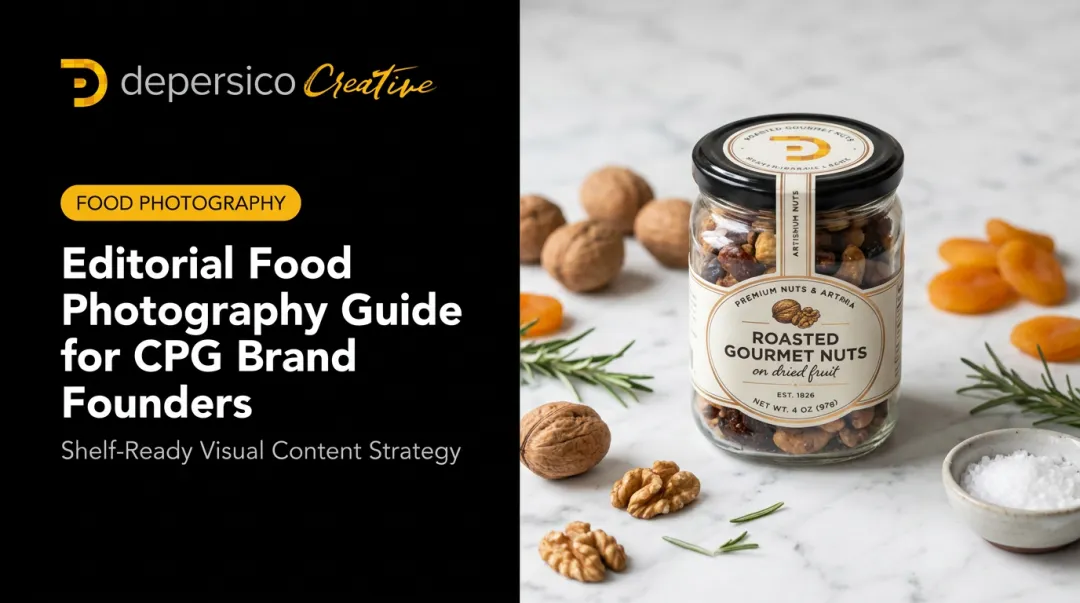
A linen napkin, a marble surface, and a worn wood table each signal a different brand identity. A natural/organic brand and a bold/indulgent snack brand should not share the same prop vocabulary — the environments communicate brand positioning before the consumer reads a word.
Everything in the frame must earn its place. Props and environmental choices aren't decoration — they're brand communication. When the same team handles both packaging design and photography, this alignment happens naturally because the visual language is already established. When separate vendors are involved, that cohesion has to be deliberately engineered, and it often isn't.
Types of Shots Every Food Brand Needs
Most food brands need three distinct categories of images, each serving different commercial functions.
Packshots
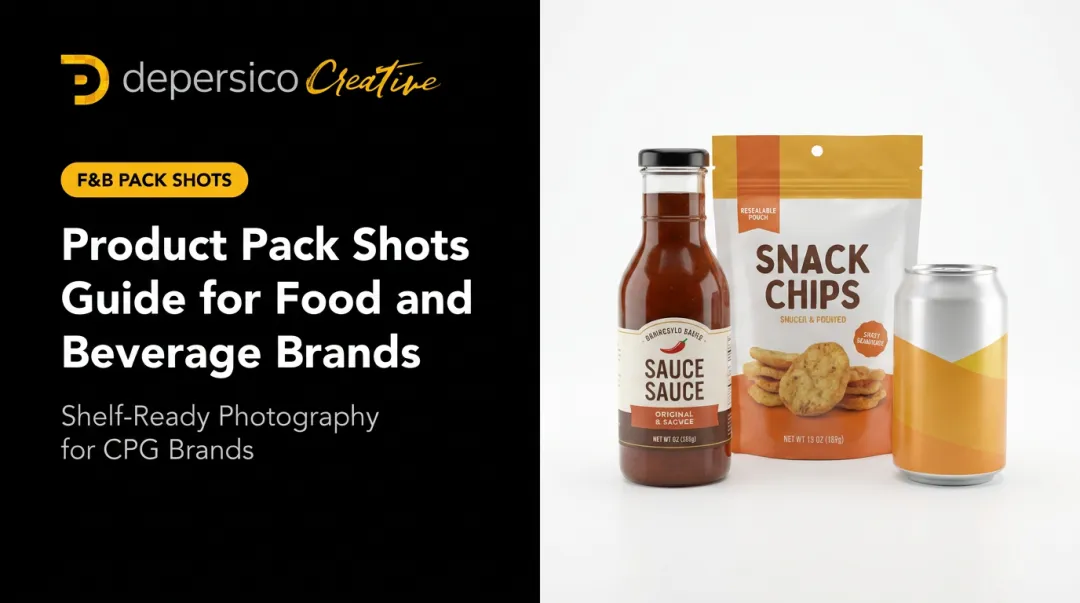
Clean, precise images of the product package used on e-commerce listings, retailer presentations, and brand websites. What distinguishes a high-end packshot from a basic one:
- Color accuracy matched against the physical product sample
- Reflection control on glossy surfaces
- Resolution that survives zoom without revealing flaws
Platforms like Amazon recommend at least six product images, with the main image requiring a pure white background (RGB 255/255/255) and the product filling at least 85% of the frame. Instacart requires similar standards. Both are hard requirements for retail compliance — and the packshot is often the most critical image a food brand owns.
Hero Product Shots
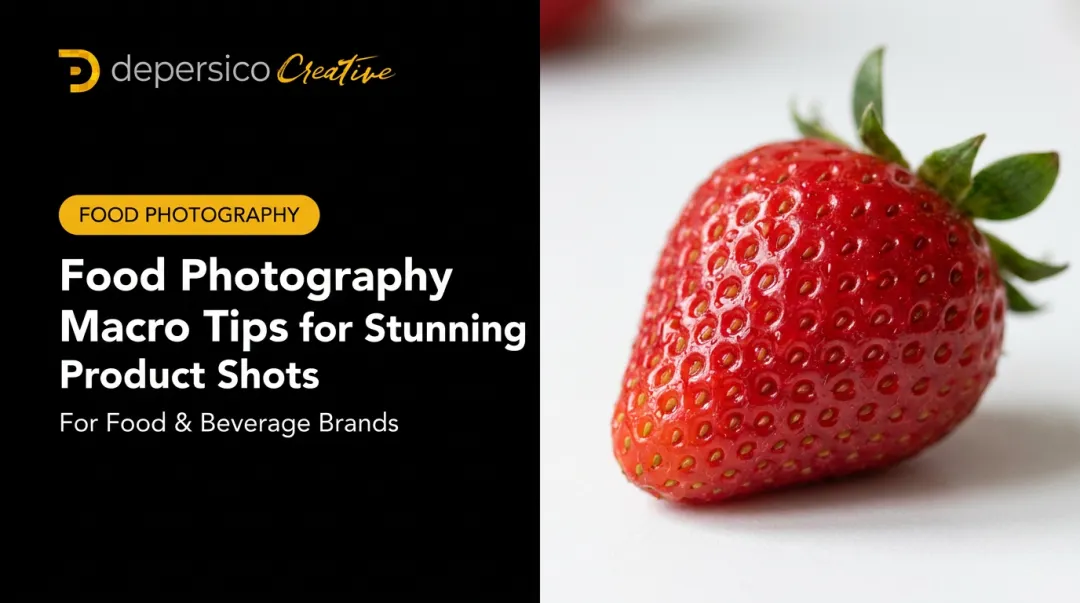
The beauty shots that create appetite appeal: the steaming bowl of soup, the cross-section of a stuffed pastry, the poured glass of a beverage. These live on front panels, in advertising, and across social media.
Hero shots are built carefully:
- Food stylist prepares multiple versions of the hero plate simultaneously
- Lighting is pre-set and tested before food arrives on set
- Photographer works quickly once the hero plate reaches peak appearance
- Team cycles through backup plates as the hero degrades

That process discipline translates directly into commercial results. DePersico Creative's work with J. Skinner Baking is one example. The packaging redesign featured a professional product photo showing the interior of the pastry when cut open — specifically highlighting moist pecan fillings and airy layers — combined with a see-through panel. This photography-driven redesign contributed to 210–340% sales growth for the brand.
Lifestyle and Contextual Shots
Images that place the product in a real-world usage moment — a breakfast table, a quick weeknight dinner setting, a family meal. These shots show shoppers exactly where and how the product fits into their daily routine — which is often what tips a consideration into a purchase.
Lifestyle shots are particularly powerful for:
- Social media content calendars
- In-store secondary displays
- Digital advertising where emotional resonance drives click-through
- Email campaigns and retail packaging back panels
The Production Process: From Concept to Final Image
Pre-Production
The quality of pre-production is the single biggest predictor of shoot-day efficiency. Every hour of planning prevents multiple hours of expensive on-set problem-solving.
A professional pre-production process covers:
- Creative brief — brand identity, target audience, shot list, desired mood, usage contexts
- Mood board development — establishing visual references for lighting style, prop vocabulary, and composition approach
- Prop sourcing — selecting and testing backgrounds, surfaces, serving vessels, and secondary props
- Food stylist briefing — sharing product samples, flavor profiles, and key visual attributes in advance
- Studio preparation — confirming all technical setups before shoot day

When photography and packaging design are developed by the same team, pre-production is more efficient — the creative brief doesn't need to be translated between vendors. The color palette, typography, and composition language from the package design inform photography decisions from the start.
Shoot Day
A professional food shoot operates in a defined hierarchy:
- Art director — oversees the overall creative vision and brand alignment
- Photographer — executes technically, manages lighting and capture
- Food stylist — manages all food preparation and plate appearance
- Prop stylist — maintains set integrity and environmental consistency
Each role feeds into the next, which is why sequence matters as much as staffing. Lighting setup and testing happen before food arrives. Hero shots come first, while the team's energy is highest and the food is at peak appearance. Secondary and lifestyle shots follow. Professional food shoots run on tight timing because perishable subjects have a performance window measured in minutes, not hours.
Post-Production
Post-production in food photography has a clear job: make the final image match the real product as closely as possible.
Legitimate retouching includes:
- Color correction matched against the physical product
- Removal of dust or surface imperfections visible under studio light
- Tonal consistency across an entire product line
What it doesn't include: adding steam that wasn't there, altering food colors to misrepresent the product, or digitally rebuilding textures.
The FTC evaluates food advertising based on its overall net impression — meaning misleading imagery can violate Section 5 of the FTC Act even when individual claims are technically accurate. That's a compliance risk no brand should take on for the sake of a more dramatic photo.
Asset Delivery
Final deliverables should be organized for how brand teams actually work:
- TIFF for packaging and print (high resolution, uncompressed)
- JPEG/PNG for digital, e-commerce listings, and social
- Platform-specific exports sized to Amazon, Walmart, and Instacart specifications
- Consistent naming conventions that allow brand teams to find the right file format without guessing
How High-End Photography Drives Food Brand Growth
Shelf Performance
In a retail grocery environment, the front-of-pack image is often the only marketing tool available at the moment of purchase. There's no sales rep, no ad, no influencer — just the package on the shelf competing for attention.
NIQ research found that top-performing package designs are noticed by nearly 70% more consumers than bottom-performing designs. Their separate analysis also showed that optimized CPG packaging can increase forecast sales volume by up to 5.5%, while 90% of redesigns fail to create meaningful market-sales impact.
The difference between those outcomes often comes down to whether the photography is doing commercial work or just occupying space on the label.
Digital Commerce
Online, there's no sensory backup. For food brands selling through their own site, Amazon, or grocery delivery platforms, the product photo carries the entire purchase decision.
NIQ data shows that increasing a grocery product listing from one image to five images raises add-to-basket rates from 8.53% to 18.9%. More than 90% of shoppers now participate in both online and in-store grocery shopping, with U.S. online grocery projected to reach $388 billion by 2027. Brands that show up with weak imagery in digital channels are leaving conversion on the table.

Brand Equity Over Time
Each high-quality visual touchpoint compounds brand recognition. A brand that produces consistent photography across packaging, advertising, social media, and retail presentations builds recall that grows more valuable with every consumer touchpoint.
Those touchpoints include:
- Packaging photography that stays current with each product iteration
- Advertising visuals consistent with shelf appearance
- Social content that reflects the same lighting, styling, and color palette
- Retail and trade show materials that match the brand's digital presence
Brands that treat photography as a one-time expense tend to accumulate visual inconsistency as new materials get produced by different vendors over time. When the packaging, the website, and the trade show booth no longer look like the same brand, shoppers notice — and that dissonance erodes the trust that strong product quality is working to build.
Choosing the Right Creative Partner for Your Food Brand
Not all product photographers are food photographers. And not all food photographers understand the commercial requirements of CPG brands — retailer spec compliance, packaging color accuracy, the difference between a lifestyle shot for Instagram and an e-commerce main image.
When evaluating a food photography partner, ask:
- Do you have food-specific studio and styling experience — not just product photography experience?
- Do you handle both packaging design and photography, or will I need to coordinate between vendors?
- Can you share examples from my product category with documented outcomes?
- What does your pre-production process look like?
- How do you ensure color accuracy for images that will appear on packaging?
- How are final files delivered, organized, and formatted for different platforms?
The Integrated Advantage
The strongest results happen when photography and package design are developed in alignment, not in sequence. When the same creative team controls both, the colors, textures, and composition language that appear on the package carry through consistently across all marketing materials. When separate vendors are involved, that alignment has to be negotiated — and it rarely holds perfectly.
DePersico Creative's model combines food and beverage brand strategy, package design, and in-house food photography — including a fully equipped test kitchen and studio — under one roof. That integration produces measurable outcomes because photography functions as a strategic element of the same creative system, not a separate deliverable:
- Sea Best: Product line expanded from 9 to 34 products; secured first Northeast distribution
- Idahoan: 75% incremental sales increase in the casserole segment
- J. Skinner: 210–340% sales growth across the product line
Frequently Asked Questions
How much does high-end product photography cost?
Cost varies based on number of SKUs, shot types required, team size, and whether styling, art direction, and post-production are included. The more relevant question is ROI — how long will these images be used and across how many channels? Request detailed project-based quotes from studios rather than comparing day rates without context.
What is the difference between high-end food photography and standard product photography?
Standard photography prioritizes clarity and platform compliance. High-end food photography is designed to communicate perceived value, create appetite appeal, and build brand identity — every lighting, styling, and composition decision is intentional and brand-directed, not just technically adequate.
What types of shots do food brands typically need?
Three core categories: packshots (for packaging and retail listings), hero product shots (for advertising, front panels, and campaigns), and lifestyle contextual shots (for social media and emotional brand connection). Most brands need all three for different deployment contexts.
How do I prepare my food products for a professional photo shoot?
Send product samples and flavor profiles to the food stylist in advance, and confirm prop and background direction aligns with your brand guidelines. Run a pre-production briefing to lock in the shot list and creative direction before shoot day. Changes made before the shoot cost a fraction of what they cost on set.
Do I need a food stylist for a high-end shoot?
For any shoot involving plated food or hero product shots, yes — a food stylist is essential. They maintain food appearance under studio conditions across multiple takes, which is a specialized skill set beyond the photographer's scope.
How does food photography impact on-shelf performance?
Packaging imagery is often the only marketing touchpoint available at the moment of purchase. Images that convey clear appetite appeal and quality directly influence trial rates — particularly with new products where the image carries the full persuasive load.