For food and beverage brands, that number isn't just a market statistic. It's the reality your product faces every day: a crowded shelf, a distracted shopper, and a purchase decision that happens in seconds.
Succeeding in that environment takes more than a great product. It takes a creative and marketing partner who understands the specific mechanics of food and beverage — how retail buyers think, how shoppers decide, and how packaging communicates value before a single word gets read.
This guide breaks down what a CPG agency is, what it actually does for food and beverage brands, and how to choose the right one for where your brand is today.
Key Takeaways
- CPG agencies specialize in food brand growth — covering package design, brand strategy, and retail positioning that general agencies can't match
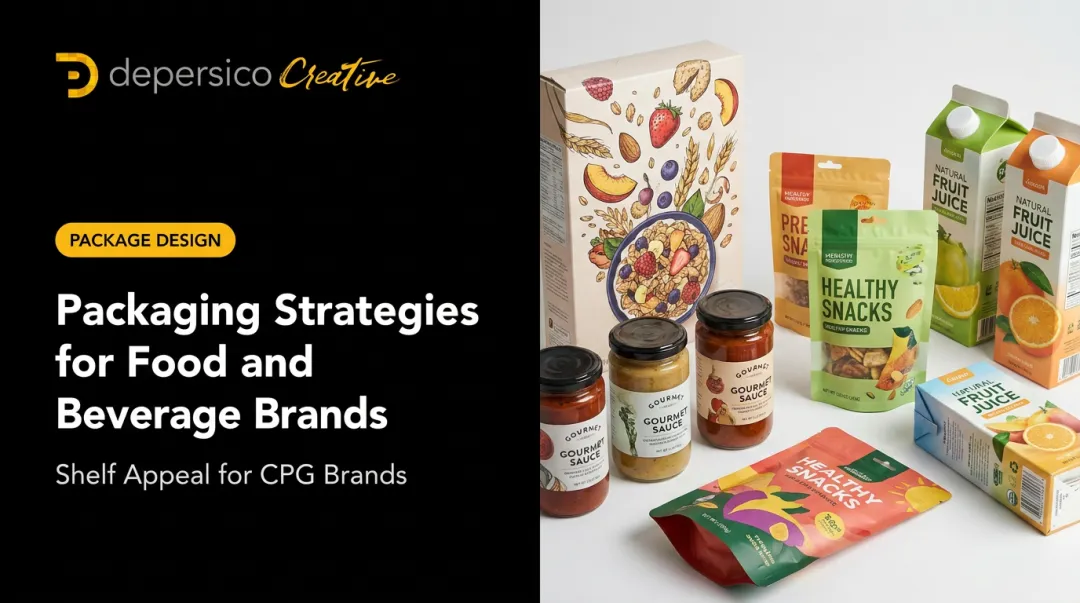
- Food packaging is your most powerful sales tool — shoppers decide in about 13 seconds
- General marketing agencies often lack the category-specific fluency that food brands need
- Match the agency to your specific gap — packaging, photography, or retail strategy — not just their general portfolio
- Project-based pricing makes specialist-level expertise accessible to brands at any stage
What Is a CPG Agency?
A CPG agency is a specialized partner that helps food, beverage, personal care, and household goods brands grow their sales, strengthen their brand identity, and connect with shoppers. What sets a CPG agency apart is deep knowledge of the category dynamics that drive — or kill — a brand at retail.
What Makes a CPG Agency Different
The key word is "specialized." Unlike a general marketing or design agency, a CPG agency understands the specific dynamics that determine whether a food or beverage product succeeds:
- How shoppers make purchase decisions in seconds at the shelf
- What retail buyers evaluate during a line review
- How packaging communicates quality and trust before a word is read
- How to build trial and drive repeat purchase
Types of CPG Agencies
"CPG agency" is a broad term that covers different types of specialists:
- Brand identity and package design agencies — build visual identity and packaging that earns attention in under five seconds on shelf
- Digital marketing and paid media agencies — run paid social, retail media networks, and performance campaigns to drive online and in-store conversion
- Full-service CPG agencies — handle strategy, creative, and marketing execution under one roof
- Retail and shopper marketing agencies — manage trade promotion, in-store activation, and retail buyer relationships
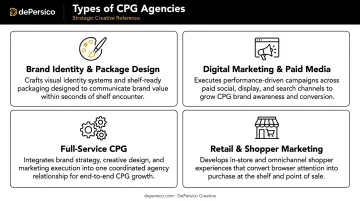
Food and beverage brands often work with more than one type — a package design agency for launch, a shopper marketing firm for retail execution. Knowing which gap to fill first determines which kind of agency to hire.
What Does a CPG Agency Do for Food and Beverage Brands?
The scope varies by agency type, but most CPG agencies working with food and beverage brands provide some combination of these core capabilities.
Brand Identity and Package Design
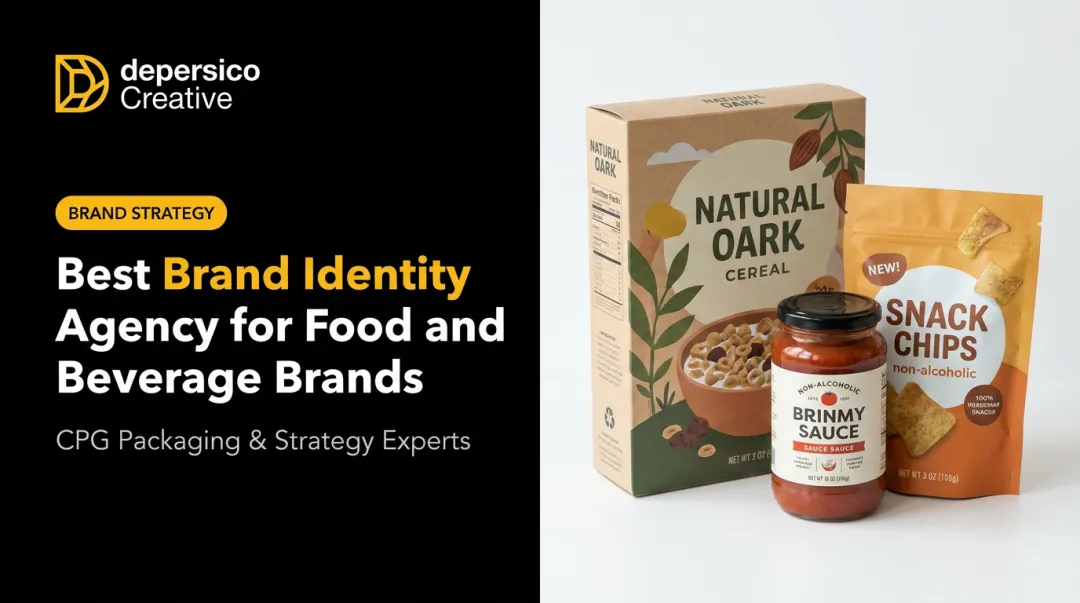
For food and beverage brands, the physical package is often the single most important piece of marketing collateral. It works as an in-store advertisement, a trust signal, and a purchase trigger all at once.
CPG creative agencies develop or refresh visual identity, structural packaging, and brand messaging to make products stand out at the point of sale. For agencies like DePersico Creative, this work starts well before any design tools open. Their process begins with a SWIFI brand analysis — a visual perception assessment identifying Strengths, Weaknesses, and Ideas for Improvement — ensuring every design decision is grounded in how the product actually competes on shelf.
Digital Marketing and Paid Media
U.S. retail media spending was projected to exceed $62 billion in 2025, growing by more than $10 billion year over year. That scale reflects how central digital channels have become for CPG brands.
The digital marketing side includes:
- Paid social (Meta, TikTok)
- Paid search and retail media networks (Amazon Ads, Instacart)
- Influencer marketing and content creation
- E-commerce content and listing optimization
The best agencies tie media spend to actual shelf velocity, not just clicks or impressions.
Food Photography and Content Creation
Food and beverage brands live and die by visual appetite appeal — whether on packaging, social media, or e-commerce listings. A specialized CPG agency brings professional food styling, test kitchen access, and photography designed to make products look irresistible across every channel.
DePersico Creative's fully equipped test kitchen and studio is a direct example: the capability to shoot food photography in-house, from product angles to plated serve suggestions, ensures that appetite appeal is consistent from package to shelf to digital shelf.
Brand Strategy and Consumer Positioning
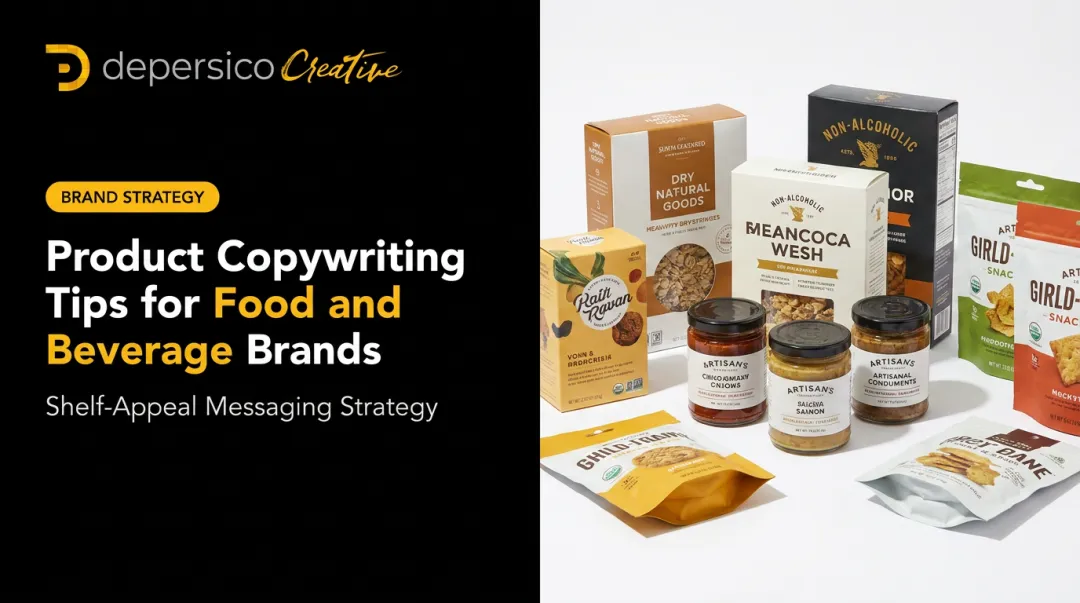
CPG agencies help brands articulate their unique value proposition, identify the right target shopper, and craft the language and messaging that compels a trial purchase.
This includes creative linguistics — the deliberate selection of words and phrases for on-package copy. DePersico Creative's work with J. Skinner pastries illustrates this: phrases like "100 layers of authentic Danish" and sensory descriptors like "smooth, dreamy, and delicious" were purpose-built to create cravings at the shelf, not simply describe what's inside.
Retail and Shopper Marketing
Retail-focused CPG agencies cover the full path to purchase: building retailer pitch decks, advising on trade promotion, managing retail media networks, and developing shopper marketing programs that convert awareness into an item in the cart.
CPG Agency vs. General Marketing Agency: Why Specialization Matters
A general marketing or design agency can produce attractive work. What it typically can't provide is the category-specific fluency that determines whether a food or beverage brand actually sells.
The Knowledge Gaps That Show Up in Practice
When a food brand hires a generalist, specific gaps tend to surface:
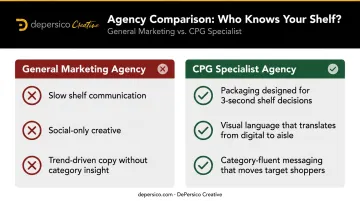
- Packaging that looks polished but communicates slowly — design that wins awards but loses shoppers in the three seconds they spend at the shelf
- Creative that performs on social but doesn't translate to shelf — visual language that reads well on a phone screen and creates no recognition in the aisle
- Messaging that's on-trend but doesn't connect — copy that reflects category vocabulary without understanding what actually moves the target shopper
The Real Cost of Category Ignorance
These gaps have a price. Food and beverage brands operate with tight margins, fast purchase decisions, and intense shelf competition. The agency you hire should have deep experience working inside those constraints, not be learning them on your budget.
An agency that has spent decades designing food packaging already knows what a generalist has to research:
- How flavor communication works visually — and which cues trigger appetite versus skepticism
- What health and lifestyle signals read as credible versus clinical to a real shopper
- Why a single wrong color choice can silently push a product into the wrong category
Why Packaging Is the Most Underrated CPG Marketing Tool
Most food brands pour budget into digital advertising and pull back just before the finish line — the shelf.
NIQ reports that shoppers look at a product for an average of 13 seconds before deciding. That's not much time for a package to communicate the product's story, quality, appetite appeal, and key differentiators — and earn a place in the shopper's cart.
Most food brands underinvest in this asset relative to its impact.
Packaging as a Conversion Tool
Effective food packaging isn't just visual design. It's a strategic selling system. Every element — color, typography, photography, hierarchy, copy — must work together to communicate value in the time it takes a shopper to glance at a shelf.
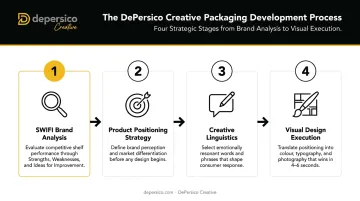
DePersico Creative operationalizes this through a structured process:
- SWIFI brand analysis — evaluating how existing packaging performs against competitors, identifying where differentiation is possible
- Product positioning strategy — defining how the product should be perceived before any design decisions are made
- Creative linguistics — selecting the specific words and phrases that create emotional or logical connection with the target shopper
- Visual design execution — translating positioning into color, typography, photography, and hierarchy choices that perform at retail
For the Idahoan Steakhouse line, a single sub-brand name — "Steakhouse" — repositioned a commodity potato product as a premium, restaurant-quality experience. That's creative linguistics at work: one word that changed how a shopper categorized the product.
What Packaging Redesigns Can Deliver
Designalytics' research on packaging effectiveness provides useful reference points. GoodPop saw sales rise 40% following its 2021 packaging redesign, while Hershey's recorded a 9% sales increase post-redesign. These are named cases, not universal guarantees — external market conditions always play a role — but they show what's possible when packaging is designed to sell, not just contain.
A strong food and beverage CPG agency pairs strategic packaging work with professional in-house food photography to ensure appetite appeal is consistent across packaging, e-commerce listings, and marketing materials. DePersico Creative has worked with national brands including Kellogg's, Campbell's, and McCormick — maintaining both capabilities in-house so strategy, design, and photography stay aligned from brief to shelf.
How to Choose the Right CPG Agency for Your Food or Beverage Brand
The right agency depends on where your brand is in its lifecycle and what its biggest growth constraint is. A startup preparing to launch needs a different partner than an established brand whose packaging has gone stale.
Food and Beverage Category Experience
Go beyond general CPG experience. Ask specifically about food and beverage case studies.
The sensory, emotional, and purchase-behavior dynamics of food are distinct from other CPG categories. An agency with direct food brand experience understands appetite appeal imagery, flavor communication, and health or lifestyle positioning — nuances that generalists miss because they've never had to develop them for a real client's sales results.
Specialization That Matches Your Core Need
Identify your primary gap before hiring:
- Brand identity and packaging? Find a specialist with a food-heavy design portfolio
- Digital marketing and retail media? Seek agencies with CPG-specific media buying experience and retail measurement capabilities
- Food photography and content? Ask about in-house studio capabilities, food styling, and e-commerce content production
- Retail strategy? Prioritize experience with trade promotion and retailer pitch development
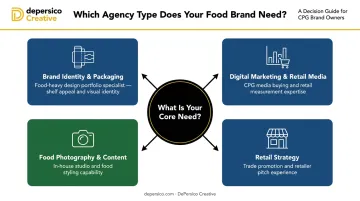
A specialist who excels at your core need will outperform a generalist who offers everything. Ask exactly who will work on your account day-to-day and what their specific food brand experience looks like.
Pricing Structure and Accessibility
CPG agency pricing varies widely. Clutch's marketplace data places U.S. packaging design agency rates at $100–$149 per hour, with average food and beverage packaging project sizes below $10,000 (though scope, SKU count, structural design, photography, and production artwork can significantly push that number higher).
Project-based engagements are generally more accessible for startups and emerging brands. Full-service monthly retainers suit scaled brands with ongoing needs. Evaluate agencies on pricing transparency and flexibility relative to your current stage.
DePersico Creative's project-based model is a direct example: brands of any size can access specialist-level expertise — including SWIFI analysis, creative linguistics, package design, and food photography — without committing to a large ongoing retainer.
Proof of Results: Case Studies and Client Roster
Ask for case studies in your specific category. An agency whose portfolio is dominated by food and beverage brands will have sharper instincts and more relevant creative benchmarks than one where CPG is a small practice inside a larger generalist shop.
When reviewing their work, look at:
- The specific brands they've served and what category those brands compete in
- The problems those brands faced going in
- How the agency's work contributed to measurable outcomes — shelf performance, distribution gains, launch results
A strong portfolio in your category tells you more than a shelf of general creative awards.
Frequently Asked Questions
What is a CPG agency?
A CPG agency is a specialized firm that helps consumer packaged goods brands grow through brand strategy, creative services, packaging, and marketing — all tailored to the fast-moving consumer goods category. Unlike general agencies, CPG specialists understand shelf competition, shopper psychology, and the retail dynamics that determine whether a product succeeds.
What does CPG stand for?
CPG stands for Consumer Packaged Goods — everyday products consumers buy repeatedly, such as food, beverages, personal care items, and household supplies. The category is defined by retail shelf distribution and highly competitive point-of-sale environments.
What is an example of a CPG company?
Well-known CPG examples include Campbell's (fiscal 2024 net sales of $9.6 billion), McCormick (approximately $7 billion in annual sales across 150 countries), and Unilever (whose Foods Business Group generated EUR 12.9 billion in 2025 turnover). CPG companies range from large multinationals to small regional food startups — all competing for consumer attention at the shelf.
What does a CPG agency do for food and beverage brands?
A CPG agency helps food and beverage brands stand out and drive sales through services such as package design, brand identity, digital marketing, food photography, creative linguistics, and retail strategy. The best agencies treat packaging as a conversion tool, not just an aesthetic exercise.
How do I choose the right CPG agency for my food or beverage brand?
Prioritize food and beverage category experience over general creative credentials. Match the agency's specialty to your brand's core gap — whether that's packaging, digital marketing, photography, or retail strategy. Ask for case studies in your specific category and look for transparent pricing that matches your growth stage.
How much does it cost to hire a CPG agency?
Costs vary by scope and agency type. Clutch's marketplace data suggests packaging design agency rates of $100–$149 per hour, with total project costs scaling based on complexity. Smaller and emerging brands should look for agencies offering project-based pricing rather than large fixed retainers.