Introduction
Walk down any grocery aisle and you'll feel it immediately: the sheer volume of products competing for the same shopper's attention. FMI reports that the average U.S. supermarket carries 33,248 items, and most of them get passed without a second glance.
According to NIQ, shoppers look at a product for roughly 13 seconds before making a choice — about the length of a deep breath to make a case for itself.
In that window, ingredient lists don't close the sale. Certifications don't either. What moves a product from shelf to cart is a story — one that makes the shopper feel something the moment they see it.
This article covers what brand storytelling means for food and beverage brands, the core elements that make a food brand story work, how to build one, and why your packaging is often doing more storytelling than any other channel you own.
Key Takeaways
- The average U.S. supermarket carries over 33,000 items — storytelling is how brands earn the shelf space that matters
- Effective F&B brand stories lead with emotion and position the consumer as the hero — features come second
- Authenticity is the foundation — consumers, especially younger ones, disengage from narratives that feel manufactured
- Packaging is the primary storytelling medium for retail brands: it must communicate the full brand story in seconds
- Small F&B brands often have a natural storytelling advantage that large CPG companies can't replicate
What Is Brand Storytelling for Food and Beverage Brands?
Brand storytelling is the practice of using authentic narratives to communicate a brand's identity, values, and personality — going beyond product features to build something shoppers actually feel.
For F&B brands, that story often lives on a package, in a product name, or in a single photo of a dish long before it ever appears in an ad.
Storytelling vs. Traditional Marketing
The distinction matters. Traditional marketing pushes product benefits and promotions — brand storytelling builds a relationship.
Consider the difference between two frozen dinner brands:
- Brand A lists ingredients, protein content, and prep time
- Brand B tells the story of a grandmother's Sunday recipe, now made accessible for busy families
Same product category. Completely different emotional territory. Brand B has already won before the shopper reads a single claim.
Why Food Is Uniquely Suited to Storytelling
Food is personal in a way that most product categories aren't. People connect it to memory, family, culture, and identity. Harvard Business Review's research on emotional connection confirms that emotionally connected customers buy more often, are less price-sensitive, and recommend brands to others at higher rates — and food is one of the most natural categories for triggering that connection.
At DePersico Creative — a food and beverage branding agency that has worked with brands like Idahoan, Ball Park, and DaVinci — the philosophy is direct: "There's a story behind every ingredient, flavor choice, and picture on your packaging." The work is to surface that story and translate it into something shoppers feel at the shelf.
The Core Elements of an Effective Food Brand Story
Not all brand stories connect. The ones that do share five consistent characteristics.
Authenticity
In F&B, authenticity isn't optional. Research published in the International Journal of Consumer Studies found that perceived brand authenticity directly affects food-brand purchase intention. Stackla's consumer survey found that 86% of Gen Z and 81% of Millennials are more likely to buy from brands that feature real, unmanufactured content.
A story rooted in genuine origins — a family farm, a founder's actual passion, a real problem the product solves — will outperform an engineered narrative every time. Identifying what is true about a product has to happen before any creative execution begins.
Emotional Resonance
Food triggers powerful emotional responses: nostalgia, comfort, adventure, indulgence, nourishment. Effective F&B brand stories identify the specific emotion their product taps into and build consistently around it.
- A hot sauce brand lives in thrill and boldness
- A heritage grain bread brand lives in craftsmanship and nourishment
- A family snack brand lives in togetherness and comfort
That emotion has to hold across every touchpoint — packaging, social content, advertising, and in-store displays — not just where the brand feels most comfortable expressing it.
A Clear Hero: The Consumer
The strongest food brand stories don't make the brand the hero. They make the consumer the hero — and position the brand as the guide that helps them achieve something.
Not "we make great pasta sauce." Instead: "here's how you become the person who brings people together around a table." That shift moves the brand from vendor to partner — and it's the difference between a product people buy once and one they come back to.
Simplicity and Clarity
A brand story has to work at the speed of shopping. In retail, that means distilling the narrative to its essence: a short name, a few words on the front panel, one image. A shopper who can't read the story in 4–6 seconds won't read it at all — they'll move to the next product.
Consistency Across Touchpoints
The story has to hold whether a consumer encounters the brand on social media, in a store, or in a TV spot. Key touchpoints for F&B brands include:
- Product packaging (front and back panel)
- Website and e-commerce listings
- Social media content
- In-store displays and point-of-sale materials
- Trade advertising and sell sheets
When each channel tells a slightly different story, consumers notice — even if they can't articulate why. That gap erodes trust faster than most brands expect.
Types of Brand Stories That Work in Food and Beverage
Most successful F&B brand stories fall into one of four archetypes — and the most powerful brands often blend two.
| Story Type | What It Communicates | Example |
|---|---|---|
| Origin Story | Heritage, authenticity, passion | A hot sauce brand started by a chef from Louisiana |
| Mission-Driven Story | Values alignment, purpose | A commitment to fair trade or sustainable sourcing |
| Ingredient/Sourcing Story | Quality, transparency, trust | Single-origin, farm-to-table, non-GMO sourcing |
| Lifestyle Story | Identity and belonging | Adventurous eating, clean living, family togetherness |
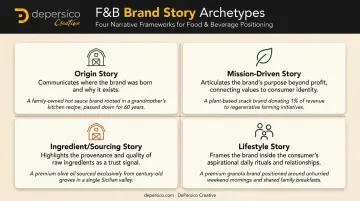
Take a family-owned salsa brand that pairs an origin story with an ingredient sourcing narrative — the founder's grandmother's recipe, made with peppers from a specific regional farm. Neither element alone is as strong as both together.
That sourcing detail matters more than most brands realize. FMI and NielsenIQ found that 64% of shoppers would switch brands for more detailed product information — which means ingredient and sourcing stories are actively driving purchase decisions, not just building goodwill.
How to Build Your Food Brand Story: A Step-by-Step Guide
Step 1 — Uncover What's Genuinely True
Brand story building starts with excavation, not invention. Before any creative work begins, ask:
- Why does this product exist?
- What problem does it solve?
- What does the founder or team care deeply about?
- What's unique about how it's made or sourced?
DePersico Creative's SWIFI process — which stands for Strengths, Weaknesses, and Ideas For Improvement — is built around exactly this kind of structured honesty. It's the first step in every brand engagement they take on, deliberately positioned before any design or copy work begins.
Step 2 — Know Your Shopper
Demographics tell you who's buying. To build a story that sticks, you need to go a layer deeper:
- Values — what they believe in and stand behind
- Aspirations — who they're trying to become
- Emotional triggers — what moves them to act
A brand targeting health-conscious millennials will tell a fundamentally different story than one targeting budget-conscious families — even with the same product. Consumer insight should shape every word and image in the brand narrative, not just the media plan.
Step 3 — Define Your Brand Voice and Personality
The way a brand speaks is part of its story. Is it warm and nostalgic? Bold and irreverent? Clean and minimal?
F&B brands need a consistent voice that carries through naming, taglines, packaging copy, and social content. DePersico Creative uses a discipline called creative linguistics to identify the specific words and phrases that create the strongest emotional appeal for a brand's target consumer, applied across everything from product names and taglines to back-panel copy. Their Yummy Health work is a direct example: packaging copy used punchy, memorable phrasing to communicate one emotional idea (healthy food that actually tastes great) rather than a list of functional claims.
Step 4 — Build the Narrative Arc
Every effective story has a conflict, a hero, and a resolution. For F&B brands:
- Conflict — the problem or gap (bland, processed snacks with no real alternative)
- Hero — the consumer who's frustrated and looking for something better
- Resolution — the brand, whose founder felt the same way and set out to create a real option
When the consumer sees themselves in the conflict, they're already invested in the resolution before they've tried the product.
Step 5 — Express the Story Visually
Color palette, typography, illustration style, food photography, and packaging structure all communicate the brand's narrative before a single word is read.
Professional food photography — capturing the product with genuine appetite appeal, in context — is one of the most direct bridges between a brand story and a purchase decision.
How Food Packaging Becomes Your Brand's Most Powerful Storytelling Tool
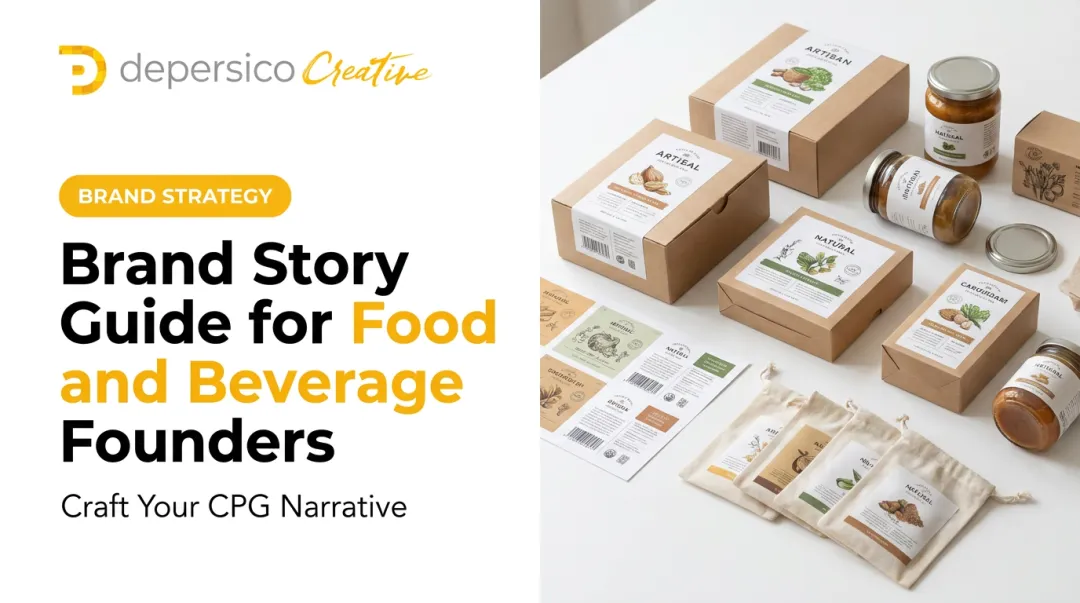
For F&B brands sold at retail, the package is not just a container. It is the primary brand storytelling medium. Unlike digital channels that require consumers to seek out your content, the package meets the shopper at the most critical moment: the point of decision.
What Packaging Storytelling Looks Like in Practice
Every element of the package is a storytelling layer:
- Front panel — the emotional hook; answers "why should I care?" in seconds
- Name and tagline — carries brand voice and personality
- Back panel — deepens the story for consumers who are already interested
- Photography or illustration — communicates quality and creates appetite appeal
These elements must work as a cohesive narrative system. When they don't, when the color palette signals one thing and the copy signals another, the story breaks down and shoppers move on.
The Real Cost of Packaging That Doesn't Tell the Story
Brands often don't realize their packaging is sending the wrong signals until sales stagnate. Common breakdowns include:
- Wrong color cues that position the product in the wrong price tier
- Weak appetite photography that removes the emotional purchase trigger
- Confusing copy hierarchy that buries the lead claim
DePersico Creative's SWIFI process is specifically designed to catch these breakdowns before they become sales problems. By evaluating visual hierarchy, ingredient claims, brand differentiation, and consumer perception cues through a competitive lens, it gives brands a clear picture of where their packaging storytelling is underperforming and concrete direction for fixing it.
Packaging Redesigns Drive Real Results
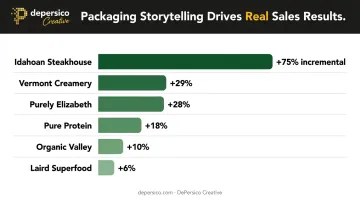
The business case for getting packaging storytelling right is quantifiable. Designalytics' 2024 award data, based on in-market sales and consumer testing, documented the following for food brands that executed strong redesigns:
| Brand | Sales Change After Redesign |
|---|---|
| Vermont Creamery | +29% |
| Purely Elizabeth | +28% |
| Pure Protein | +18% |
| Organic Valley | +10% |
| Laird Superfood | +6% |
DePersico Creative's own portfolio reflects similar results. After repositioning the Idahoan Steakhouse sub-brand around a restaurant-quality narrative, with photography and creative linguistics evoking a familiar steakhouse dining experience, the brand achieved a 75% incremental sales increase and grew casseroles segment share from 11.6% to 23.1%.
Ball Park Buns, refreshed around American outdoor tradition through a storytelling-grounded packaging and campaign overhaul, went on to become the #1 national hot dog bun brand.
Storytelling Is Not Just for New Brands
Established brands often need to revisit their narrative. Their target consumer may have evolved, the category may have grown more competitive, or the original story has gone stale.
DaVinci pasta had experienced five consecutive years of declining sales before a storytelling-grounded refresh reversed the trend. J. Skinner Baking, a wholesale bakery with no prior retail presence, built a premium brand identity from scratch using artisanal storytelling cues and grew 210–340% following relaunch.
In both cases, the story came first. The visual execution followed.
Frequently Asked Questions
What is brand storytelling?
Brand storytelling is the practice of using authentic narratives to create emotional connections between a brand and its consumers. Rather than leading with product features, it communicates values, identity, and purpose in a way that makes the brand memorable, relatable, and compelling enough to motivate purchase.
What are the four pillars of brand storytelling?
The four commonly cited pillars are:
- Authenticity — the story must be genuinely true
- Emotional connection — it must evoke a feeling
- Relatability — it must reflect the audience's own values or experiences
- Consistency — it must be expressed the same way across all touchpoints
What are the 5 C's of storytelling?
The 5 C's are:
- Circumstance — setting the scene
- Curiosity — the question the story promises to answer
- Characters — the people driving the narrative
- Conversations — the voice that makes the story feel human
- Conflict — the tension that drives the story toward resolution
How does brand storytelling apply to food packaging?
Packaging is often the primary storytelling medium for retail F&B brands. The front panel hooks the shopper emotionally, the name and tagline carry brand voice, and the overall visual design communicates quality and identity — all in the few seconds before a purchase decision is made.
What makes a food brand story authentic?
Authenticity comes from grounding the narrative in something genuinely true — a real founding story, a real sourcing commitment, a real problem the founder set out to solve. Consumers detect manufactured narratives quickly, and once they do, they disengage for good.
How can small food brands compete with large CPG brands through storytelling?
Small food brands often have an inherent storytelling advantage — a genuine founder story, a distinctive origin, a specific community or mission — that large corporations struggle to replicate authentically. By leaning into what makes them real and specific, smaller brands can build fierce loyalty even against better-resourced competitors.