Introduction
A shopper takes about 1.5 seconds to decide whether a product earns their attention at the shelf. In that window, your packaging either stops them or loses them — and a brand without a clear story almost always loses.
Food and beverage is a crowded category. Products look similar side-by-side, and price alone never wins loyalty. What wins is a story — one that makes a shopper feel something before they even open the package.
This guide walks through how to build that story: what a brand story actually is (and what it isn't), the four core elements that make F&B stories work, how to write yours step by step, and how to translate it across every touchpoint — from your About page to your packaging.
Key Takeaways
- A brand story answers why you exist, not just what you sell — and that answer must show up consistently on every customer-facing surface
- The customer is the hero of your story; your brand is the guide
- Authenticity requires specificity — vague claims like "made with love" signal nothing
- Packaging is your most critical storytelling surface, often the only one a shopper sees
- Story consistency across touchpoints builds trust; inconsistency breaks it
What Is a Brand Story (and Why F&B Founders Need One)?
A brand story is the narrative that communicates your mission, values, and purpose in a way that creates emotional connection. It answers why you exist — not what you sell, not how you make it, not what your margins are.
A tagline is a single phrase. A mission statement is a declaration. A brand story is the living narrative that weaves those together into something a customer can see themselves in.
Why It Matters More in Food and Beverage
Food is personal. Shoppers are choosing what goes into their bodies, what they feed their families, and what values they want to support with their dollars. Emotional resonance shapes preference — and it's what gets shoppers to switch.
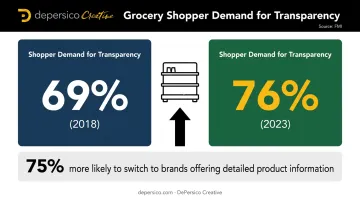
75% of grocery shoppers said they were more likely to switch to a brand that offered more detailed product information, according to FMI. By 2023, transparency ranked as important to 76% of grocery shoppers — up from 69% in 2018. That's not a trend. That's a baseline expectation your brand story needs to meet.
What a Brand Story Is NOT
- A company history timeline listing your founding date and milestones
- A list of product features or nutritional benefits
- A mission statement sitting alone on your About page
- A press release about your latest product launch
The story is what connects your "why" to your customer's life. Without it, your product competes on price and placement — and that's a race most brands lose.
The 4 Core Elements of a Compelling F&B Brand Story
Element 1 — Authenticity
In food and beverage, authenticity isn't a brand value you choose — it's a baseline requirement. Consumers are scrutinizing ingredient sourcing, production methods, and founder credentials more than ever.
Your story must be grounded in something real: a genuine origin, a family tradition, a problem the founder personally experienced. Manufactured authenticity unravels quickly, especially when competitors and review sites give shoppers easy ways to check claims.
Element 2 — A Clear Conflict or "Why"
Every great brand story starts with a problem. Not a vague market opportunity — a specific friction that someone felt and decided to fix.
Two examples that work:
- "There were no clean-label snacks that kids actually wanted to eat — so we made them."
- "Local farmers had no direct path to consumers, and the best produce was being lost to the supply chain."
The conflict creates tension. Tension makes the story worth following.
Element 3 — The Customer as Hero
This is where many founders go wrong. They center the story on their own journey — the late nights, the sacrifices, the breakthrough moment. That's interesting background, but it's not a brand story.
The customer is the hero. Your brand is the guide. The product exists to help them feed their family better, eat more adventurously, or support the values they believe in. Shift the frame from "look what we built" to "here's what this means for you" — and the story becomes magnetic.
Element 4 — Consistency Across Every Touchpoint
A brand story that only lives on your About page is incomplete. Shoppers encounter your brand across a dozen surfaces before they ever buy — and every one of them needs to carry the same voice and values:
- Product name and packaging copy
- Social media tone and visual style
- Ad creative and campaign messaging
- Sell sheets and grocery buyer pitch decks
Inconsistency creates distrust, especially for indie brands competing against established players with years of shelf presence. If your packaging sounds warm and personal but your Instagram reads like a corporate press release, shoppers notice. The story breaks, and so does the relationship.
Across all of it, lean on sensory and emotional language — words that evoke taste, memory, smell, or place. Food is experiential. The strongest F&B brand stories don't just describe a product; they put the reader in the moment of eating it.
Common Types of Food and Beverage Brand Stories
Type 1 — The Founder's Origin Story
The most common in F&B, and for good reason: it's personal, verifiable, and relatable. A founder spots a gap — a dietary need, a missing flavor, a family recipe worth scaling — and sets out to fill it.
Pete & Gerry's Organic Eggs is a textbook example. The Ward family farm faced an existential threat when industrial production made commodity egg farming unsustainable for small operations. Rather than fold, Jesse LaFlamme moved into organic eggs in 1996 and eventually partnered with over 350 family farms across 18 states.
That conflict — industrialization threatening family farming — became the brand's entire identity: "Healthy Hens, Healthy Eggs, Healthy Planet."
Not every founder story begins with a crisis. Tom First and Tom Scott of Nantucket Nectars stumbled into theirs: post-college jobs on Nantucket harbor, a peach nectar mixed out of necessity. They built a founder-led identity so literal they put themselves on the labels.
Type 2 — The Mission-Driven Story
Brands built around a cause: sustainable sourcing, supporting small farmers, reducing food waste, making healthy food accessible. Alter Eco, founded around fair trade and regenerative agriculture, integrates its mission into every product claim and sourcing decision.
This type builds strong community loyalty — but only when the mission is genuinely embedded in the business, not just the marketing. Shoppers who care about sustainability are also the ones most likely to call out greenwashing, and a single viral callout can undo years of brand equity.
Type 3 — The Ingredient or Craft Story
Raaka Chocolate centers its entire narrative on how its chocolate is made — from unroasted cacao, with transparent sourcing disclosures that show exactly where each bar's ingredients come from. There's no celebrity founder story. The craft is the story.
This approach works especially well for premium and specialty brands competing on quality rather than price. It educates consumers while building a case for why the product costs more — turning what could be a dry feature list into a compelling reason to buy.
How to Write Your Food and Beverage Brand Story: Step-by-Step
Step 1 — Know Your Customer Before You Know Your Story
Brand story development starts with audience understanding, not self-reflection. Who is buying this product? What do they value? What problem are they trying to solve at mealtime or at the shelf?
Research from McKinsey and NIQ found that products with ESG-related claims averaged 28% cumulative growth from 2017 to 2022 versus 20% for products without — across roughly 600,000 SKUs across 32 CPG categories. That correlation tells you something real about what today's shoppers are reaching for.
Ask yourself:
- Is my customer motivated by health, convenience, ethics, or indulgence?
- What do they know (or assume) about brands in my category?
- What would make them pick my product over the one next to it?
Step 2 — Identify the Conflict at the Heart of Your Brand
Ask yourself: What was wrong or missing before I created this product?
Prompting questions to help you find it:
- Was there a personal health crisis that existing products couldn't address?
- Was there a cultural tradition or family recipe disappearing from the market?
- Did a frustrating shopping experience leave you convinced there had to be a better way?
- Was there a quality gap you couldn't close with anything already on the shelf?
The conflict you identify becomes the emotional anchor of your story. The sharper and more specific it is, the more believable and memorable your brand becomes.
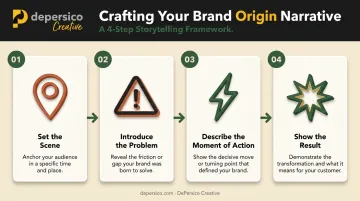
Step 3 — Craft Your Origin Narrative
Structure it simply:
- Set the scene — Where and when did this begin? Who was involved?
- Introduce the problem — What was wrong, missing, or broken?
- Describe the moment of action — When did the founder decide to do something about it?
- Show the result — What did that decision create?
Keep it human. Avoid corporate language. The more specific your details, the more credible the story — "my grandmother's kitchen in rural Pennsylvania" lands differently than "a love of homemade food." Name the place. Name the person. Give the reader something to picture.
Step 4 — Compress the Narrative Into a Core Message
After drafting the full narrative, compress it into one or two sentences that can anchor everything else. This isn't your tagline — it informs your tagline.
A useful structure:
"[Brand] exists because [founder/problem]. We believe [core value], so we [what you do differently]."
This distilled version should be able to appear on the back of your package, in your pitch deck, and in your Instagram bio without changing meaning.
Step 5 — Test It With Real People
Share the story directly with members of your target audience. Skip colleagues, investors, and family — they're too close to give you an honest read. The questions that matter:
- Does this feel real to you?
- Do you understand what makes this brand different?
- Does it make you want to try the product?
Pay attention to where people feel confused or unconvinced. Those are the gaps between the story you think you're telling and the one your audience is actually hearing.
Step 6 — Write It in Your Brand Voice
The story must be told in a voice consistent with your brand's personality:
- Playful and irreverent — snack brands, novelty foods, anything where fun is the point
- Warm and heritage-driven — when mealtime, family tradition, or a grandmother's recipe is the foundation
- Mission-first — when the cause and the product are inseparable, lead with conviction
Food brands benefit especially from sensory-rich language. Don't describe your hot sauce as "flavorful" — describe what it does to a taco at 7pm on a Tuesday. That specificity is what makes someone reach for it.
Where Your Brand Story Lives: Translating It Across Touchpoints
A brand story isn't a document. It's a living narrative that gets expressed differently depending on where the customer encounters you.
Where F&B brands need to tell their story:
- The About page (full origin narrative)
- Product packaging (compressed, high-impact version)
- Social media (short hooks, behind-the-scenes reinforcement)
- Pitch decks and sell sheets (positioning and proof)
- In-store displays and point-of-sale materials
Packaging: Your Most Critical Storytelling Surface
The package is often the only touchpoint a shopper has with your brand. In a grocery aisle, you don't get a pitch meeting — you get a second of eye contact and a label.
Every element of your packaging is a storytelling decision: the product name, the on-pack copy, the imagery, the color palette, the descriptors on your back panel. None of it is neutral.
DePersico Creative approaches this through a process that includes creative linguistics — selecting the most compelling words and phrases that create an immediate emotional or logical connection with shoppers. The difference between "premium ingredients" and copy that makes someone reach for your product comes down to that word-level precision.
Their SWIFI brand analysis process (Strengths, Weaknesses, and Ideas for Improvement) specifically evaluates whether a package is communicating brand story effectively at the shelf level by examining visual hierarchy, ingredient claims, and the cues that drive trial. Gaps identified in SWIFI directly shape the creative direction that follows.
Their case work shows what story-driven packaging looks like in practice:
- DaVinci® pasta: A back-panel brand narrative that explained not just what the product was, but why it was worth choosing over the competition
- J. Skinner® Baking: Copy like "100 layers of authentic Danish" and names like Wildly Pecan Danish did the brand story work in a handful of words
- IDAHOAN® Steakhouse™: An entire packaging system built around one message — restaurant-quality results at home — that contributed to a 75% incremental sales increase

Social Media: Matching Format to Story Depth
- YouTube/blog: Full origin story, founder interviews, farm-to-shelf documentaries
- Instagram/TikTok: Short emotional hooks, single-image moments that convey the brand's personality instantly
- Behind-the-scenes content: Farm visits, kitchen prep, founder moments — the kind of content that makes authenticity visible rather than claimed
Internal Consistency Matters Too
Your external story only holds if the internal version matches. Everyone on your team — even in a company of three — should be able to summarize your brand story in two sentences. A misaligned sales pitch, an off-brand email, or a trade show booth that contradicts your packaging can quietly erode the credibility you've worked to build.
Common Brand Story Mistakes F&B Founders Make
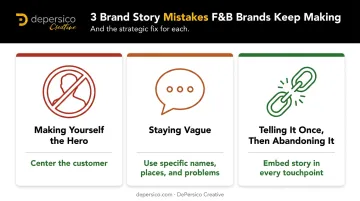
Most brand stories fail for the same three reasons:
Making yourself the hero. Founders often lead with credentials and personal journey. Your customer doesn't need to admire you — they need to see themselves in your story. The frame shifts when you ask: what does this solve for them?
Staying vague. "We use only the best ingredients" appears on thousands of products and says nothing. Specificity is credibility. Name the farm. Name the grandmother. Name the exact problem you couldn't find a solution to anywhere else. Vague claims are forgettable by design.
Telling the story once, then abandoning it. Many founders write a strong About page, then revert to feature-focused copy everywhere else. Your brand story has to run through every customer-facing asset — especially packaging. The moment the story breaks, the emotional connection breaks with it.
Avoiding these mistakes is half the work. The other half is building a story consistent enough to hold up at every touchpoint, from your sell sheet to the shelf.
Frequently Asked Questions
What is a brand story example?
Pete & Gerry's Organic Eggs built its entire brand around the conflict between industrial farming and the family farm. That founding tension, survive or reinvent, became a story of organic commitment and community that now spans 350+ partner farms. The conflict was real, the mission was verifiable, and the customer could see their own values in it.
What should a food and beverage brand story include?
Four things: an authentic founding conflict, the customer at the center, a clear core belief, and a consistent voice. That voice should show up across packaging, digital channels, and marketing materials — not just on the About page.
How do you communicate a brand story on product packaging?
Through every element: product naming, on-pack copy, imagery, and design. Each carries a piece of the narrative. Together, they need to create connection and sensory appeal within the few seconds a shopper spends at the shelf.
How long should a food brand story be?
The full origin narrative can run several paragraphs on your website. The distilled version, the one that travels, should be one to two sentences. That's what goes on the back of your package and into your pitch deck.
What makes a food brand story feel authentic?
Specificity: real names, places, and moments. Consistency between what the brand claims and what it actually does. And centering the customer's experience rather than the founder's achievement.
Can a small food startup compete with big brands through storytelling?
Often more effectively. Small brands have genuinely personal, verifiable origin stories, something large corporations can't replicate. Today's shoppers are actively seeking brands with authentic founders and clear values, and smaller brands can deliver that credibility in ways that national players struggle to match.