Introduction
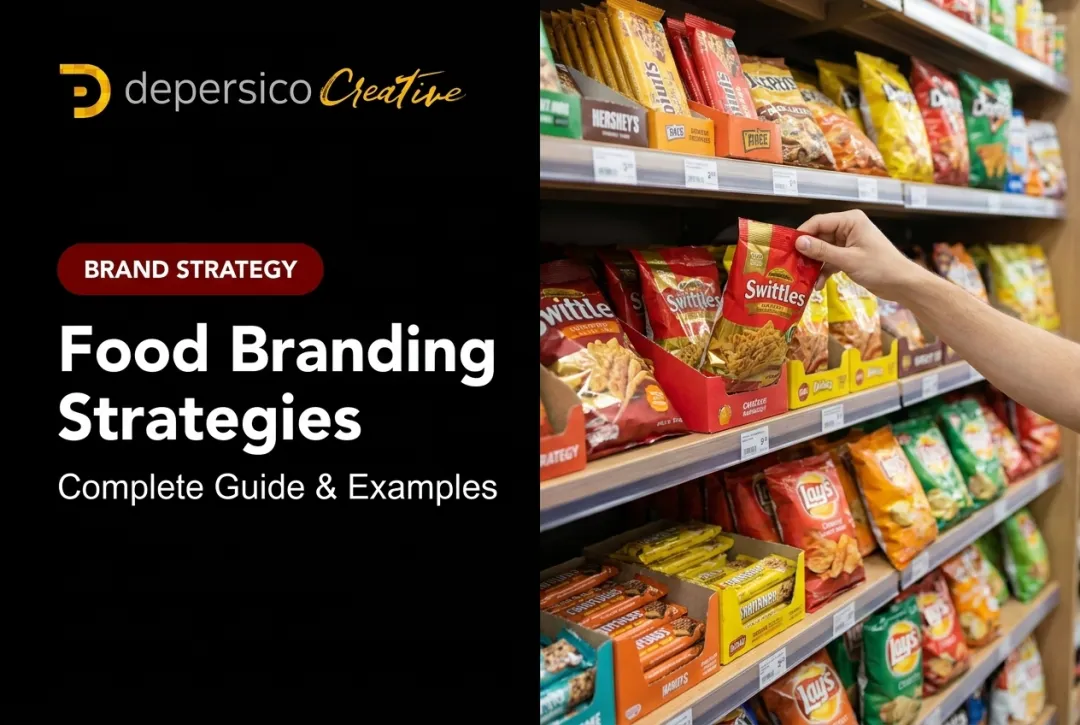
A food product has roughly six seconds to earn a shopper's attention before they move on. That's not a metaphor — NIQ's 2024 omnichannel research confirmed that in-store selections happen in under six seconds. In a supermarket carrying more than 33,000 SKUs, packaging does the selling. There's no rep on the floor, no pitch — just the package.
That's why brand identity carries higher stakes in food and beverage than in almost any other industry. A weak identity doesn't just underperform — it makes a genuinely good product invisible on a shelf crowded with competitors.
This article covers five of the best brand identity agencies specializing in food and beverage — what they do, who they serve, and what sets each one apart. It also covers the criteria every food brand should use when choosing an agency partner.
Key Takeaways
- F&B brand identity goes far beyond logos — packaging, photography, messaging, and shelf appeal all drive purchase decisions.
- Generalist agencies underperform in food and beverage — they lack the category expertise that purchase-decision packaging demands.
- The strongest F&B agencies combine brand strategy, packaging design, creative linguistics, and food photography under one roof.
- This guide evaluates DePersico Creative, JKR, Landor, Coley Porter Bell, Blue Marlin, and others — so you can match the right agency to your brand's stage and goals.
- Prioritize F&B track record, in-house capabilities, senior-level access, and transparent pricing when evaluating agencies.
What Sets Food and Beverage Brand Identity Apart
Packaging is the first — and often only — brand touchpoint before a shopper decides to buy. That means every visual and verbal decision on a package is directly tied to revenue. According to a 2018 Ipsos survey of 2,002 US adults, 72% said packaging design often influences their purchase decisions. That's not a soft metric — it's the commercial reality food brands operate in every day.
The Unique Challenges of F&B Branding
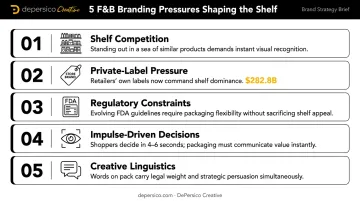
Food and beverage branding involves a set of pressures that most other categories don't face:
- Shelf competition — 33,000+ SKUs per supermarket, all competing for the same visual real estate
- Private-label pressure — Store brands hit $282.8B in sales in 2025, with 23.5% unit share, according to PLMA — and they're growing three times faster than national brands
- Regulatory constraints — FDA and USDA rules govern what must appear on every label, leaving designers limited canvas for brand expression
- Impulse-driven decisions — Shoppers aren't reading; they're scanning. Packaging must communicate quality, flavor, and brand story at a glance
- Creative linguistics — The specific words and phrases on a package can create craving or kill interest in an instant
Why Generalist Agencies Fall Short
A generalist agency may produce beautiful work — but beautiful doesn't always sell at shelf. Common failure points include:
- Defaulting to either cluttered packaging or stripped-down "clean" aesthetics that fail to communicate why the product is worth buying
- Misapplying color — using generic design trends instead of category-specific color psychology (pink for an organic kale smoothie, for instance)
- Missing labeling compliance requirements around allergen disclosures, nutrition facts panels, and regulated terms like "all-natural" or "low-fat"
- Designing without any competitive shelf context — no category audit, no planogram review, no knowledge of retail buyer expectations
Each of these failure modes has a real cost. Tropicana's 2009 rebrand stripped away decades of brand recognition, and Ad Age reported unit sales fell 20% and dollar sales dropped ~$33M in just seven weeks before the company reversed course.
That's what's at stake when packaging decisions are made without category-specific expertise.
Top Brand Identity Agencies for Food and Beverage Brands
These agencies were selected based on demonstrated F&B or CPG specialization, portfolio depth, client diversity, and the ability to deliver measurable shelf impact.
DePersico Creative
Background: DePersico Creative is a three-generation, family-owned agency founded in 1977 and headquartered in West Chester, PA. With over 45 years of exclusive focus on food and beverage brand identity and package design, it's one of the few agencies in the US that does nothing but F&B. National clients include Kellogg's, Campbell's, McCormick, and Ball Park.
What sets them apart: DePersico's singular category focus means every tool, process, and team member is built around the food retail environment. Their proprietary SWIFI (Strengths, Weaknesses, and Ideas For Improvement) visual perception assessment gives clients a structured analysis of current shelf performance before any design work begins.
Key differentiators:
- Integrates food photography and packaging design through an in-house test kitchen and studio, so every image reinforces brand positioning from the start
- Connects clients directly with agency leadership on the first call, bypassing junior account managers
- Assigns the same senior team to startup SKU launches and national portfolio work, with no tiered service levels
- Uses project-based pricing to make specialized F&B branding accessible at every stage of growth
Their core mission, "Create Cravings. Inspire Trial.", reflects a specific commercial philosophy: packaging is a selling tool with 4–6 seconds to work.
| Attribute | Details |
|---|---|
| Specialization | Exclusive focus on food and beverage brand identity, package design, creative linguistics, and food photography |
| Notable F&B Clients | Kellogg's, Campbell's, McCormick, Ball Park, DaVinci, Idahoan, Sea Best, J. Skinner, Yummy Health |
| Pricing Model | Project-based; accessible to startups and national brands; direct access to agency President |

Jones Knowles Ritchie (JKR)
Background: JKR is a globally recognized branding agency with studios in New York and London, known for deep specialization in CPG and F&B brand identity. They've spent decades building some of the most recognizable identities in the category.
Their edge: JKR's F&B portfolio is hard to match at scale. They created Heinz's first-ever global masterbrand in 2020 — a unified identity system covering strategy, logo, packaging, typography, and tone of voice across more than 20 product categories. Their 2022–2023 global redesign of M&M's, centered on the ampersand as a visual system, earned entry in the D&AD Annual 2023. Their award-winning work spans fast-moving consumer goods, with deep capabilities in packaging and structural design, brand storytelling, and naming.
| Attribute | Details |
|---|---|
| Specialization | CPG and F&B brand identity, packaging design, naming, brand storytelling, structural design |
| Notable F&B Clients | Heinz, M&M's, Burger King, Budweiser, Stella Artois, Dunkin' Donuts |
| Pricing Model | Available upon request; best suited for mid-to-large F&B brands with significant budgets |
Landor
Background: Landor is a global brand consultancy founded in 1941 with 30 locations worldwide. Originally established by Walter and Josephine Landor, the firm has a long track record working with food and beverage companies on complex, multi-market brand identity projects.
Why they stand out: Landor operates at enterprise scale. Their Kellogg's engagement — a cereal-pack redesign using Simstore methodology — reported a 6% lift in purchase rate. For Topo Chico, they developed the full brand identity and packaging system; the brand expanded from 30 US states to all 50 and saw a 30% increase in differentiation metrics. Best suited for large food companies managing multi-product portfolios or global rebrand initiatives.
| Attribute | Details |
|---|---|
| Specialization | Enterprise brand strategy, visual identity, and large-scale brand transformation for global F&B and CPG companies |
| Notable F&B Clients | Kellogg's, Topo Chico, Walmart |
| Pricing Model | Available upon request; enterprise-level pricing; best for organizations with complex brand portfolios |
Coley Porter Bell
Background: Coley Porter Bell is a London and New York-based branding agency founded in 1978, recognized for deep expertise in FMCG and food and beverage brand identity. A WPP company, they've worked with some of the world's largest grocery and food brands.
Key differentiators: Their grocery portfolio is particularly strong. Tesco own-label strategy, Tesco Finest premium packaging, and M&S Plant Kitchen are all public case studies. The effectiveness record is notable: M&S Plant Kitchen won Bronze at the 2020 DBA Design Effectiveness Awards, and the Flawsome! rebranding project won Gold, with DBA reporting 540% sales growth in the year after relaunch against a 100% target.
| Attribute | Details |
|---|---|
| Specialization | FMCG and F&B brand identity, packaging strategy, brand revitalization, retail shelf optimization |
| Notable F&B Clients | Tesco, Tesco Finest, M&S Plant Kitchen, Flawsome! |
| Pricing Model | Available upon request; serves mid-to-large FMCG and grocery brands globally |
Blue Marlin
Background: Blue Marlin is an international brand design consultancy operating since 1993, with offices in Bath, London, Mumbai, and New York. They describe themselves as a brand acceleration agency combining strategy and creativity.
What makes them different: Blue Marlin focuses on making brands relevant through strategic design. Current F&B case studies include Isigny Sainte-Mère dairy branding, Complan nutritional brand packaging, and Kinnie soft drink branding. Their offices across four countries make them a practical option for brands needing consistent creative direction across international markets.
| Attribute | Details |
|---|---|
| Specialization | FMCG and F&B brand identity, packaging design, brand positioning, strategic creative partnerships |
| Notable F&B Clients | Isigny Sainte-Mère, Complan, Kinnie |
| Pricing Model | Available upon request; offices in multiple countries for brands needing international reach |
How to Choose the Right Food and Beverage Brand Identity Agency
What Good Agency Selection Looks Like
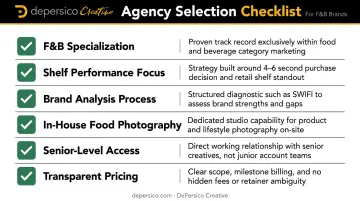
Agencies on a serious shortlist for F&B brand identity work should demonstrate all of the following:
- Documented F&B or CPG specialization — not just a few food projects scattered through a general portfolio
- Packaging and shelf performance focus with experience in how design performs at retail, not just how it looks in a PDF
- A structured brand analysis process that maps your brand's competitive position before any design work starts
- In-house food photography capability (photography handled outside the brand strategy creates visual inconsistency; in-house integration keeps every image aligned with the strategy that drove it)
- Senior-level access throughout the project , not just at pitch
- Transparent or project-based pricing : agencies that can't discuss pricing structure early rarely get easier to work with later
Knowing what to look for is half the equation. The other half is recognizing the selection errors that quietly derail projects before they start.
Common Mistakes That Cost Brands Time and Money
The most expensive agency selection errors aren't obvious until after the invoice clears:
- Hiring a generalist agency because they showed one or two food projects in their pitch deck — category fluency and occasional category experience are not the same thing
- Choosing on aesthetics alone without asking how the work performed at shelf — beautiful packaging that doesn't drive trial is expensive decoration
- Not clarifying who works on the account — larger agencies routinely pitch with senior talent and execute with junior staff. Ask directly: who is the day-to-day creative lead on this project?
- Skipping the brand analysis phase to save time — launching packaging without a competitive shelf audit is designing blind
If an agency checks those boxes on both lists, you've found one worth a serious conversation.
Conclusion
The right brand identity agency for a food or beverage brand understands the shelf, the shopper, and the commercial pressure every product faces the moment it's placed in front of a consumer. General creative capability isn't enough. Food brands need an agency that has spent years in the category, knows retail dynamics, and treats packaging as the strategic selling tool it actually is.
For brands at any stage — launching a first product or revitalizing an underperforming line — DePersico Creative has been doing exactly that since 1977. Their SWIFI assessment process, in-house photography capabilities, and direct senior-level access make them a strong fit for brands that want specialized expertise without the overhead of an enterprise agency. Contact DePersico Creative to start with a SWIFI assessment and see where your brand stands on the shelf.
Frequently Asked Questions
What brands have the best brand identity in food and beverage?
Coca-Cola is consistently ranked among the strongest — appearing in Interbrand, Kantar BrandZ, and Brand Finance global rankings year after year. The best F&B brand identities share a common thread: instant visual recognition, emotional resonance, and packaging that creates craving before a word is read.
What is the 3-7-27 rule of branding?
It's a mental model describing consumer familiarity thresholds: roughly three exposures to notice a brand, seven to remember it, and 27 to trust it enough to prefer it. The numbers aren't from a single peer-reviewed study, but the principle holds — in F&B packaging, every exposure either advances or squanders that familiarity.
What does a food and beverage brand identity agency do?
A specialized F&B brand identity agency develops the visual, verbal, and strategic elements that define how a product looks, communicates, and competes on shelf — covering logo design, packaging, food photography, brand naming, and product positioning, all calibrated for the retail environment.
How much does it cost to hire a food and beverage brand identity agency?
Costs depend on scope, number of SKUs, and deliverables. Project-based models — like DePersico Creative's — offer the most flexibility for brands at different stages, tying investment directly to what the project actually requires. Avoid agencies that can only offer open-ended retainer structures without discussing scope first.
What should I look for when choosing a brand identity agency for my food brand?
Prioritize F&B-specific experience, a structured brand analysis process, in-house food photography, transparent pricing, and confirmed senior-level involvement throughout the project — not just at the pitch. Ask to see examples of work that performed at retail, not just work that looked good in award submissions.
How long does a food and beverage brand identity project typically take?
A packaging refresh generally runs 6–10 weeks. A full brand identity project — strategy, naming, design, and photography — typically takes 3–6 months. Agencies with in-house photography and dedicated F&B teams move faster, since there are no outside vendors to coordinate.