Introduction
Picture this: a specialty sauce brand lands an email from a regional grocery buyer. The buyer is interested — but asks for a line sheet before scheduling a call. The brand scrambles, pulls together a rough PDF with product photos and a price list, and sends it off. The buyer never responds.
That line sheet didn't fail because the product was wrong. It failed because the document didn't give the buyer what they needed to say yes.
That gap matters most in food and beverage, where a line sheet is often the first real commercial conversation with a retail buyer — and many grocery buyers may never have tasted your product before reviewing it. The document has to sell on its own.
This post breaks down what a wholesale line sheet is, what food and beverage brands specifically need to include, and what separates the ones that convert from the ones that get filed away.
Key Takeaways
- Line sheets are transactional "how to buy" documents, not brand stories or product catalogs
- Food brands must include food-specific fields: UPC, case pack, shelf life, storage class, and certifications
- Product photography quality directly affects whether a buyer keeps reading
- Wholesale cost and MSRP must both appear — buyers won't place orders without them
- Limit to 5–12 pages and group products by category so buyers can navigate quickly
What Is a Wholesale Line Sheet?
A wholesale line sheet is a concise, product-focused document that gives retail buyers everything they need to evaluate and place an order. That's the job — no more, no less.
It's easy to confuse a line sheet with other sales documents, but each serves a distinct role:
| Document | Primary Purpose |
|---|---|
| Line Sheet | "How to buy" — transactional, order-focused |
| Sell Sheet | "Why this product" — single SKU, benefit-driven |
| Catalog | "Who we are" — brand story, depth, breadth |
| Lookbook | "The lifestyle" — aesthetic, aspirational |
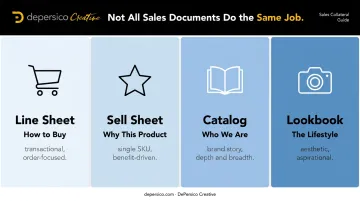
A buyer who's ready to explore ordering doesn't need your origin story — they need pricing, case pack sizes, and ordering terms. The line sheet delivers exactly that, nothing more.
When and How Line Sheets Are Used
Line sheets move through a few specific channels:
- Email outreach — sent as a PDF attachment or shared link during cold or warm buyer prospecting
- Trade shows — handed out or left behind at the booth (the Summer Fancy Food Show draws 9,000+ buyer attendees annually)
- Wholesale portals — uploaded to platforms like Faire or RangeMe for buyer discovery
For food and beverage brands, the stakes are higher than in other categories. A buyer evaluating apparel can assess quality from a photo. A buyer evaluating your hot sauce hasn't tasted it yet — the line sheet is carrying the entire first impression of the product's commercial viability.
Format Options
- PDF (static) — best for email outreach; keep file size under 5MB so it doesn't bounce or get flagged as spam
- Digital/interactive — works well for wholesale portal submissions where buyers can click through to individual SKUs or order forms
- Printed — trade shows and in-person sales calls; heavier paper stock signals quality, which matters when your product's taste can't speak for itself in the room
What to Include in a Food and Beverage Line Sheet
Food brands can't treat line sheets like apparel brands do. Retail buyers in the grocery and specialty food space need product details that other categories never think about.
Branding and Contact Information
Every page needs your brand logo, company name, and contact details. Buyers sometimes print individual pages, screenshot a product entry, or forward a single page to a colleague. Your information needs to be traceable regardless of how the document gets used.
Product Photography
RangeMe identifies product imagery as the single most important field for attracting buyer attention — describing it as the factor that determines whether a buyer opens further product details at all.
On a line sheet, product pages should feature clean pack shots: actual product in its retail packaging, on a white or neutral background, clearly lit, product filling the majority of the frame. Lifestyle images belong on the cover or about page — not on product pages where buyers are in evaluation mode.
Professional food photography is worth the investment here. DePersico Creative's test kitchen and photography studio produce pack shots built around shelf presence and packaging clarity — the two things buyers are actually evaluating at this stage.
Product Details
Each product entry on a food and beverage line sheet should include:
- Product name and SKU or item number
- Flavor or variety
- Net weight and package format (can, pouch, jar, box, etc.)
- Case pack configuration and units per case
- UPC code (UPC-12 or EAN-13 — required for retail readiness)
- Shelf life (in days, weeks, or months)
- Storage class (frozen, refrigerated, or shelf stable)
- One to two sentence product description covering taste profile, key ingredient, or standout attribute
- Relevant certifications (USDA Organic, Non-GMO Project Verified, Certified Gluten-Free, Kosher, etc.)
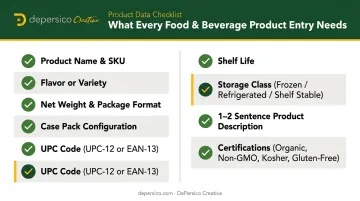
Certifications aren't just compliance markers — many wholesale platforms and retail buyers filter product discovery by certification. Missing them from your line sheet means missing buyers who are actively searching for what you make.
Pricing Information
Faire notes that wholesale requires two price points: your wholesale cost and your suggested retail price (MSRP). Both belong on every product entry.
RangeMe uses these two figures to calculate gross margin automatically, and buyers filter products by margin thresholds. If pricing is missing or vague, the buyer simply moves on.
Also include:
- Tiered pricing or volume discount structure (if applicable)
- Case price (calculated from unit cost × case quantity)
Wholesale Terms and Ordering Information
The terms page pulls together everything a buyer needs to actually place an order:
- Minimum order quantity (MOQ) — by units or dollar value
- Payment terms — net 30, credit card, prepayment, etc.
- Lead time — how long from order to shipment
- Shipping terms — who pays freight, how items are shipped
- Return and damage policy
- Whether products are available for drop shipping or must be ordered in full case quantities
Incomplete terms force buyers to follow up with questions, and that friction breaks sales momentum. Most buyers won't bother — they'll move to a vendor whose paperwork is already complete.
How to Structure Your Line Sheet Page by Page
A well-structured food and beverage line sheet typically runs 5–12 pages. Here's the recommended sequence:
The Cover Page
The cover sets the tone for everything that follows. Include:
- Brand logo (prominent)
- Line sheet title — for example, "2025 Wholesale Line — Fall Collection"
- Season or date
- A strong hero image of your product or product line
- Contact information
The cover should look like it belongs next to your packaging on a grocery shelf — same visual language, same quality.
The About Page
Keep this to one page. Answer three questions concisely:
- Who is this brand?
- What makes the product different?
- Why should a retailer trust you?
For food brands, this is the place to mention founding story, production method, key certifications, and the consumer the product appeals to. Buyers who understand your brand story are far more likely to champion your product to their category managers.
The Product Pages
Product pages are the core of the document. Recommended structure:
- 4–8 products per page, grouped by category (snacks, sauces, beverages) or by occasion
- Consistent image sizing across all entries — neutral backgrounds, same cropping approach
- Each entry: photo, SKU, size, case pack, UPC, shelf life, description, wholesale price, MSRP
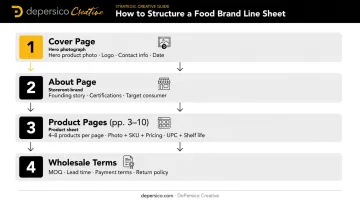
Grouping products logically helps buyers navigate fast. A grocery buyer managing 12 category reviews in one week isn't going to reorganize your line sheet for you.
The Wholesale Terms Page
This page pulls your key commercial terms into one scannable reference. Format it as bullets or a structured layout — never paragraphs. Include:
- Minimum order quantity (MOQ)
- Lead times and shipping terms
- Payment terms and accepted methods
- Return or damaged goods policy
- Ordering instructions and contact information
Buyers need to verify these details at a glance. Make it effortless to find them.
Design Tips That Make Food Brand Line Sheets Stand Out
A line sheet doesn't need to be visually elaborate. Clarity and brand consistency will outperform decorative complexity every time.
Core design principles:
- Limit fonts to one or two typefaces
- Use your brand color palette — no new colors introduced just for the line sheet
- Design visual hierarchy so the buyer's eye lands on the most important information first (image → product name → pricing)
Brand Consistency Between Packaging and Sales Materials
The single most telling signal of a market-ready food brand is when the line sheet looks like it was designed by the same team that designed the packaging. Same color palette, same typography, same visual weight.
When that consistency exists, buyers don't consciously notice it. They just trust the brand faster. Without it, the disconnect registers as unprofessionalism, even if the buyer can't articulate why.
This is why sell sheets, broker leave-behinds, and trade show materials need to draw from the same color, typography, and photography that appears on the shelf — not be designed in isolation.
The Sea Best® rebrand illustrates this well. DePersico Creative extended the brand's bold blue packaging system into trade show materials that introduced the product to retail buyers and distributors simultaneously, helping Sea Best expand distribution into the Northeast for the first time.
File Format and Delivery
- Email: PDF format, compressed appropriately for attachment or shared via Google Drive or Dropbox
- Wholesale portals: Follow platform-specific upload standards (RangeMe, for example, specifies image dimensions and file size requirements)
- Mobile: Many buyers review materials on tablets or phones — test your PDF at mobile screen size before sending
Common Line Sheet Mistakes to Avoid
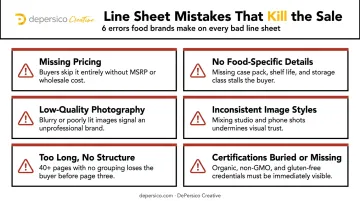
These are the errors that most reliably kill a wholesale conversation before it starts:
Missing or incomplete pricing. No wholesale cost or MSRP means buyers can't calculate margin. They move on to a supplier who makes it easy.
No food-specific details. Omitting case pack sizes, shelf life, or storage class forces buyers to email with basic questions — which signals the brand isn't ready for wholesale.
Low-quality product photography. A blurry or poorly lit product photo creates doubt about the product itself. Buyers form quality assessments from packaging imagery before anything else.
Inconsistent image styles. Mixing studio shots with phone photos across a single product page looks disorganized. Buyers notice.
Too long, no structure. A 40-page line sheet with no logical grouping doesn't get read. Feature only the products actively available for wholesale, organized so buyers can find what they need in under a minute.
Certifications buried or missing. Certifications — USDA Organic, Non-GMO Project Verified, Certified Gluten-Free — function as buyer trust signals and searchable filter criteria on wholesale platforms. They belong prominently on each product entry.
Every mistake on this list has the same root cause: making the buyer do extra work. A clean, complete line sheet removes those friction points before they become reasons to pass.
Frequently Asked Questions
What are wholesale line sheets?
A wholesale line sheet is a product document food and beverage brands share with retail buyers that includes product details, pricing, and ordering terms. It gives buyers everything they need to place an order without requiring a follow-up call.
What does a wholesale line sheet look like?
Typically a multi-page PDF with a branded cover, product images displayed alongside specs and pricing, and a wholesale terms page. The layout is clean, consistent, and organized to help buyers scan quickly.
How is a line sheet different from a product catalog?
A catalog introduces the brand and sells the story — the "why to buy." A line sheet is transactional: it covers the "how to buy" and is used once a buyer is ready to evaluate an order.
How long should a wholesale line sheet be?
Most food and beverage line sheets run 5–12 pages. Short is better — include only what a buyer needs to make a purchase decision, grouped clearly by product category or type.
What food-specific details should be in a line sheet?
Buyers expect UPC/barcode, case pack size, units per case, shelf life, storage requirements (frozen, refrigerated, shelf stable), and any certifications such as organic, non-GMO, kosher, or gluten-free.