Introduction: Why the Words on Your Food Package Matter More Than You Think
Picture a shopper moving through a grocery aisle. They're not reading — they're scanning. With 33,248 items in the average U.S. supermarket, every product is competing for a glance that lasts seconds. In that environment, your packaging copy isn't descriptive text. It's your only salesperson.
Food and beverage brands often pour resources into product development and visual design, then treat the actual words as an afterthought. That's a costly mistake. The copy on your label influences whether someone picks it up, turns it over, and ultimately buys it — or keeps walking.
This article covers the core techniques for writing food copy that sells: sensory language that triggers cravings, benefit-led messaging that resonates with shoppers, shelf-ready hierarchy, and the mistakes that cause otherwise great products to sit untouched.
DePersico Creative calls this philosophy "Create Cravings. Inspire Trial." — choosing words with the same precision you'd apply to any other strategic decision.
Key Takeaways
- Sensory-specific language (e.g., "velvety," "slow-roasted") builds appetite appeal more effectively than generic claims like "delicious"
- Lead with consumer benefits on the front panel — what shoppers experience, not just what ingredients are inside
- Front panel copy must identify the product and its key benefit within seconds
- Match your brand voice to your category's emotional register: premium, playful, nostalgic, or functional
- Generic claims like "natural" and "fresh" have lost shelf credibility; replace them with specific, substantiated language
Why Product Copywriting Is Uniquely Challenging for Food and Beverage Brands
Food copy has to do two things at once: communicate functional facts and trigger an emotional, appetite-driven response — all within a label the size of your hand.
That dual pressure has no equivalent in most other product categories. A software product page can take three paragraphs to explain a feature. A food package gets three seconds and a front panel measured in inches.
The Shelf Is Already Crowded
The average U.S. supermarket carries over 33,000 items. Even in a single category — say, pasta sauces or granola bars — a shopper faces dozens of competing SKUs at eye level. Every one of them is using color, imagery, and words to fight for the same attention. Your copy has to cut through that noise without requiring the shopper to slow down and read carefully.
The Multi-Channel Complexity
The same brand now needs copy that works across three fundamentally different contexts:
- Front panel: 3–6 words that deliver the brand promise and primary benefit in one glance
- E-commerce product detail page: Descriptive copy that converts when a shopper can't touch or see the product in person — U.S. online grocery sales hit $12.7 billion in December 2025 alone
- Social media: Short, scroll-stopping captions built for rapid consumption
Each channel demands different length, tone, and hierarchy. What works as a front-panel headline often reads as too sparse for an e-commerce description, and vice versa. Brands that excel at this treat each format as its own writing problem — with its own rules.
Use Sensory Language to Trigger Cravings
Sensory copywriting means using words that activate taste, smell, texture, and temperature before the product ever reaches someone's mouth. Done well, it puts the eating experience in the shopper's mind before they've opened the package.
Research published in Food Quality and Preference supports this: product-extrinsic cues, including label language, create sensory expectations that shape how consumers perceive a product before they taste it. The label sets the expectation. The copy either builds desire or deflates it.
Specific Beats Generic, Every Time
The difference between forgettable and craveable copy is usually specificity:
| Generic | Specific |
|---|---|
| "Rich chocolate flavor" | "Deep, bittersweet dark chocolate with a lingering finish" |
| "Crispy texture" | "Thin. Crispy. Uncompromising." (Tate's Bake Shop) |
| "Savory taste" | "Extra crunchy, thick-cut ridges" (Kettle Brand Krinkle Cut) |
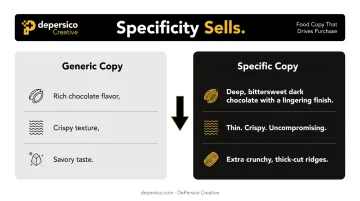
"Delicious," "fresh," and "tasty" have been on so many packages for so long that shoppers no longer register them. Specific sensory descriptors — "velvety," "smoky," "sharp," "slow-simmered," "golden-crusted" — do actual cognitive work by triggering a mental simulation of the eating experience.
Occasion and Memory-Based Language
Connecting a product to a specific moment amplifies craving through memory. Compare:
- "Great for any meal" → bland, forgettable
- "Saturday morning pancakes" or "the BBQ everyone's asking about" → immediate scene, immediate desire
This approach works because food is emotional. A descriptor that places the product inside a familiar, enjoyable ritual makes the shopper feel like they're already there.
Creative Linguistics in Practice
DePersico Creative's work with J. Skinner® bakery illustrates this approach concretely. Rather than listing pastry ingredients, the team asked: What will the consumer actually experience? The answer became the copy — phrases like "smooth, dreamy, and delicious" and "100 layers of authentic Danish" alongside product names like "Heavenly Cheese Danish" and "Wildly Pecan Danish." Each name carried emotional weight and sensory specificity. The result: 210–340% sales growth after the rebrand.
For American Flatbread, the anchor phrase "Authentic Wood-Fired" did double duty — communicating a taste experience (smoky, artisan) and a quality signal (traditional method, not mass-produced). Two jobs, four words.
DePersico Creative's "creative linguistics" process evaluates every word against four criteria before it makes the label:
- Relevance — Does it connect to what the consumer actually wants to feel or taste?
- Uniqueness — Does it stand apart from the generic language already crowding the shelf?
- Simplicity — Can a shopper absorb it in under two seconds?
- Memorability — Will it stick after the package is back on the shelf?
Words that don't clear all four don't make the cut.
Lead with Benefits, Not Just Ingredients
There's a simple distinction food brands routinely blur. Ingredients are features. What those ingredients do for the shopper is a benefit.
- Feature: "Made with whole grain oats"
- Benefit: "Keeps you full until lunch"
Shoppers don't buy ingredients. They buy outcomes — energy, comfort, confidence, ease. Copy that leads with features makes the shopper do the interpretive work themselves. Copy that leads with benefits does it for them.
Translating Clean Label Claims
Claims like "non-GMO," "organic," and "no artificial preservatives" have become table stakes in many categories. IFIC's 2024 Food & Health Survey of 3,000 U.S. adults found that while these cues matter to consumers, the most motivating framing goes beyond certification — it speaks to what the claim delivers:
- "Non-GMO" → "Clean ingredients you can actually pronounce"
- "No artificial preservatives" → "Nothing in here that shouldn't be"
- "Organic" → "Grown without shortcuts"
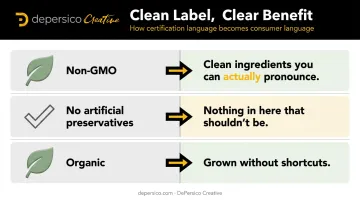
The certification proves the claim. Benefit-framed copy makes the shopper care about it.
Front Panel Focus
Your front panel should carry one primary consumer benefit: the single most compelling reason to choose this product over everything next to it on the shelf. Secondary benefits belong on the side or back panel.
How do you identify which benefit to lead with? Start with your target buyer. A parent shopping for a child's snack prioritizes different outcomes than an athlete buying a protein bar. The right leading benefit isn't the one you're most proud of. It's the one your specific shopper cares most about.
Use Cases as a Benefit Strategy
Framing a product around a specific occasion shows shoppers exactly where it fits into their life:
- "The easiest weeknight dinner"
- "Your next trail snack"
- "Built for the morning rush"
This approach removes the decision burden. Shoppers don't have to imagine where the product fits into their routine. You've already told them.
Write Copy That Works in Seconds on the Shelf
The Front Panel vs. Back Panel Split
Packaging works as a two-stage sales conversation, and each panel has a distinct job.
The front panel delivers the brand promise and primary benefit in a single glance. If a shopper can't identify what the product is — and why they'd want it — within seconds, the copy needs revision. That's the front panel's only assignment.
The back panel is the close. Once someone flips the package over, they're already interested. That's when you have room for origin stories, ingredient transparency, preparation notes, and brand narrative. Take, for example, the approach behind Kashi-style back panels: substantial real estate devoted to brand values and sourcing stories, while the front carries simplified, high-contrast claims. Each panel earns its space by serving a different stage of the shopper's decision.
Product Names and Flavor Descriptors as Headlines
Once your panels are structured correctly, the naming itself becomes your most powerful front-panel tool. Your product name or flavor descriptor functions exactly like a headline — compare:
- "Chocolate Flavor" → category placeholder
- "Midnight Brownie Crunch" → craveable, specific, searchable
Strong flavor naming does three things: it's evocative (triggers appetite), it's distinctive (stands out in the category), and it's searchable (works in e-commerce and retail search). HIPPEAS demonstrates this well with names like "Sweet & Smokin'," "Far Out Fajita," and "In Herbs We Trust" — each combining flavor identification with brand personality in a single phrase.
Formatting for Scannability
Dense paragraph copy on the back panel loses browsers before they become buyers. Use:
- Short sentences and bullet points for key callouts
- Bold text for certifications, awards, or standout claims
- Clear hierarchy — the most important information reads first, at a glance
Shoppers in a grocery aisle are scanning for signals, not reading for comprehension. Format accordingly.
Build a Brand Voice That Matches Your Food Category
Different food categories carry different emotional expectations — and copy that ignores those expectations feels off, even when the words are technically correct.
Consider how the same copywriting technique sounds across three categories:
| Category | Sensory Language Example |
|---|---|
| Craft hot sauce | "Slow-fermented. Face-meltingly bold. No apologies." |
| Children's snack | "Crunchy bites your kids actually want in their lunchbox!" |
| Organic soup | "Slow-simmered from real vegetables, the way your grandmother would have." |
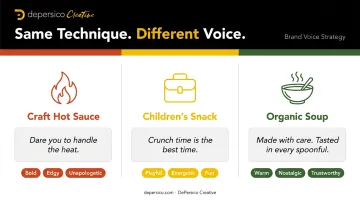
Same technique — sensory specificity — completely different execution. The craft sauce earns its edge. The kids' snack earns its energy. The organic soup earns its warmth. None of those tones would survive a swap.
Those differences aren't accidents — they reflect what each audience already expects before they read a single word. Category tone follows predictable patterns:
- Premium specialty foods call for confidence and restraint
- Snack brands run on humor and irreverence
- Comfort food brands lean into nostalgia and belonging
Writing against these expectations doesn't just feel awkward. It signals that the brand doesn't understand its own customer, and that erodes trust faster than a bad ingredient list.
Consistency Across Touchpoints
Whatever voice your packaging establishes, it must hold across every consumer touchpoint. Inconsistency makes the brand harder to recognize and trust over time. That means every surface needs to sing from the same sheet:
- Website copy and product descriptions
- Social media captions
- Sell sheets and trade show materials
- Point-of-sale displays and promotional copy
The package is usually where a consumer meets the brand first. Every piece of copy that follows either reinforces that first impression or quietly undermines it.
Common Copywriting Mistakes Food and Beverage Brands Make
The Generic Claim Trap
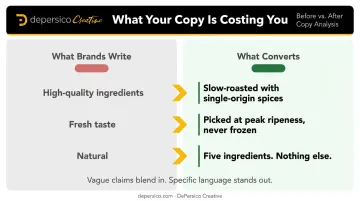
"Delicious." "High-quality." "Fresh." "Natural." These words appear on nearly every product in every category. Shoppers have stopped seeing them.
The fix is to replace vague claims with specific, substantiated language that earns the same conclusion. Instead of "high-quality ingredients," say "slow-roasted with single-origin spices." Instead of "fresh taste," describe what makes it fresh — or drop the claim entirely if you can't prove it.
FDA regulations under 21 CFR 101.95 also restrict how "fresh" can be used on labeling, which means vague claims carry legal risk alongside marketing risk.
Writing for the Brand, Not the Buyer
Founding stories, production details, and internal terminology that the brand finds meaningful are often invisible to the shopper standing in an aisle with a cart to fill.
A useful audit question: Is this sentence doing a job for the shopper, or for the brand's ego? Every line of copy should answer a question the shopper is actually asking:
- "Will I like this?"
- "Is it worth the price?"
- "Where does this fit in my life?"
If a line of copy doesn't answer one of those questions, it's working for the brand, not the buyer.
Neglecting the Back Panel
Many brands treat the back of the package as regulatory overflow — nutrition facts, allergy warnings, barcode, done. That's a missed opportunity.
A shopper who turns the package over is already engaged. They're looking for confirmation that the purchase is worth making. A well-written back panel — with a brand story, usage inspiration, or a single compelling proof point — can close the sale that the front panel started. Treat every square inch of real estate as a selling opportunity, not a compliance task.
Frequently Asked Questions
What does a product copywriter do?
A product copywriter writes the words that communicate a product's value and persuade shoppers to buy — on packaging, websites, and marketing materials. For food and beverage brands, that spans front-panel headlines, flavor descriptors, back-panel brand stories, ingredient callouts, and e-commerce descriptions.
What are the 5 C's of copywriting?
Copywriter Robert W. Bly defines them as Clear, Concise, Compelling, Credible, and Call to Action. For food packaging, where space is limited and attention is brief, clarity and credibility have to coexist with enough emotional appeal to drive the shopper to act immediately.
What is the 80/20 rule in copywriting?
Roughly 80% of your copy should focus on the reader's needs, desires, and benefits — with only 20% covering product features or brand details. For food packaging, appetite appeal and emotional resonance should dominate over specs and certifications.
How do you write food product descriptions that sell?
Start with a sensory or benefit-driven hook, then use specific descriptive language to build appetite appeal. Match the tone to your category and shopper, and choose language that makes the reader feel and want the product before they've bought it.
What words make food sound more appealing?
Specific sensory descriptors — "slow-roasted," "golden-crusted," "tangy," "velvety," "hand-crimped" — outperform vague superlatives like "delicious" or "amazing." Occasion-based language ("perfect for game day," "your new morning ritual") also boosts purchase intent by placing the product inside a desirable moment.
How is packaging copywriting different from website copywriting?
Packaging must deliver the complete brand promise in seconds, without click-throughs or scrolling. Website copy builds a longer narrative and guides readers through a funnel. Packaging compresses everything into one front-panel hook, using the back panel strategically for deeper engagement.