Introduction
Getting a product onto retail shelves requires more than a great formula and compelling packaging. Before a buyer approves your item, before a co-manufacturer runs a single batch, and before a distributor slots your product in a warehouse, someone needs a complete, accurate record of exactly what your product is.
That document is the product specification sheet.
Get it wrong, and the consequences are concrete. Undeclared allergens were the leading cause of FDA Class I food recalls for at least three consecutive years. FSIS recorded 65 recalls covering over 4 million pounds of product in 2023 alone. Retailers routinely reject new item submissions for missing or inconsistent data.
This guide is for food brand founders, product managers, and marketing teams — whether you're launching your first SKU or managing a national CPG portfolio. We'll cover what goes into a spec sheet, how different teams use it, and the mistakes that cost brands listings and compliance headaches.
Key Takeaways:
- A spec sheet is a B2B document covering ingredients, allergens, certifications, packaging specs, and shelf life
- Retailers like Kroger and distributors like UNFI require spec sheets for new item onboarding
- Allergen errors and data gaps are top causes of food recalls and retailer chargebacks
- Spec sheets must be updated whenever formulations, certifications, or packaging change
- Spec sheet and packaging misalignment triggers compliance failures and receiving rejections
What Is a Product Specification Sheet for Food Brands?
A food product specification sheet is a structured document that captures all key product attributes — physical, nutritional, regulatory, and commercial — in one standardized format. Its purpose is straightforward: every party in your supply chain, from co-manufacturers and retail buyers to logistics teams and sales reps, works from the same accurate, current product data.
How It Differs from Similar Documents
Food brands often confuse a spec sheet with related documents. Here's how they're distinct:
| Document | Purpose | Audience |
|---|---|---|
| Spec sheet | Comprehensive product record (ingredients, packaging, certifications, logistics) | B2B: retailers, co-packers, distributors, internal teams |
| Nutrition facts panel | FDA-regulated consumer nutrition declaration | Consumer-facing, on-package |
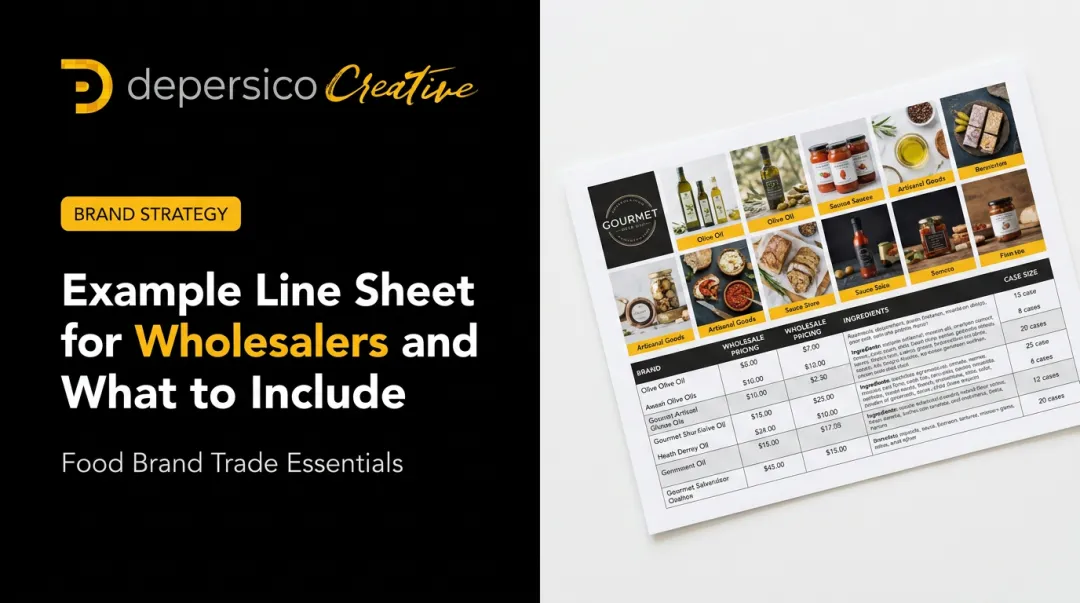
| Line sheet | Multiple-product overview with wholesale pricing | Buyers and brokers |
| Product brief | Internal exploratory document for development | Internal R&D and marketing |
Each document has a distinct job. A spec sheet pulls from the same nutritional data as your on-package panel, but it goes much further — and lands in front of a completely different audience.
Why Food Brands Need Product Spec Sheets
Food and beverage brands operate under layered regulatory requirements: FDA labeling rules under 21 CFR Part 101, USDA/FSIS standards for meat and poultry, and state-level compliance requirements.
The spec sheet is the internal document that confirms all claims, ingredients, and certifications are documented before they appear on packaging or in retail submissions.
What Goes Wrong Without One
Brands that skip formal spec sheets or treat them casually tend to run into predictable problems:
- Inconsistent data sent to retailers — different numbers showing up in buyer presentations versus onboarding portals
- Co-manufacturer errors — vague production briefs lead to batch variability and off-spec products
- Label claim violations — on-pack claims like "high protein" or "low sodium" that aren't substantiated by the formula (FDA requires at least 20% DV for "high" protein claims, and no more than 140 mg sodium per reference amount for "low sodium")
- Retailer chargebacks — packaging or process violations that trigger financial penalties when products arrive at distribution centers
- Delisting risk — retailers and distributors conduct spot checks; discrepancies between submitted data and the physical product can pull a product from distribution

Those risks have pushed major retailers to formalize their own requirements — making the spec sheet a condition of entry, not just an internal safeguard.
The Commercial Requirement
Major retail chains, club stores, and national distributors now require formal spec sheets as part of supplier onboarding. Kroger accepts synchronized item data through Syndigo, 1WorldSync, or Salsify. UNFI requires a completed New Supplier New Item Form and products to retain at least 75% of shelf life remaining at its final distribution center. KeHE routes brands through a digital submission workflow via RangeMe.
Without a current, accurate spec sheet, a brand simply cannot complete onboarding — regardless of how strong the product is.
What Goes Into a Food Brand Product Spec Sheet
A comprehensive food spec sheet covers five core categories. Each serves a different audience: internal teams, retail buyers, co-manufacturers, and logistics partners.
Product Identification and Commercial Details
Every spec sheet starts with the foundational identifiers:
- Product name and brand name
- SKU/item number
- UPC/GTIN barcode (GTIN-12 for consumer units, GTIN-14 for shipping cases)
- Product category
- Net weight or volume
- Lot codes and item variants (flavors, sizes, formats)
Accurate product identification is non-negotiable in the retail context. Retailers use GTINs and SKUs to list products, manage inventory, and trigger reorders. A single transposed digit in a GTIN can prevent a product from appearing in a buyer's system before the item ever reaches a shelf.
Ingredients and Nutritional Information
This section must mirror what will appear on the finished package label:
- Full ingredients list in descending order by weight (per 21 CFR 101.4)
- Nutrition facts per serving, formatted per 21 CFR 101.9 requirements
- Serving size and reference amount customarily consumed (RACC)
Any discrepancy between the spec sheet and the actual label is a compliance red flag. This section is typically the first thing a retail buyer or QA team checks.
On-pack claims require supporting evidence referenced in the spec sheet:
- "High protein" → requires at least 20% DV per RACC, plus protein calculation documentation
- "No added sugar" → no added sugars or functional substitutes; additional disclosure may apply
- "Low sodium" → no more than 140 mg per RACC; lab or database support required
Allergen Declarations and Certifications
The nine major allergens recognized by the FDA — milk, eggs, fish, shellfish, tree nuts, peanuts, wheat, soybeans, and sesame — must be clearly declared. Sesame was added as the ninth major allergen under the FASTER Act, effective January 1, 2023. Fish, shellfish, and tree nuts require the specific type (for example, "almond" or "salmon").
Allergen declarations in the spec sheet serve two purposes: safety compliance and retailer onboarding. Many buyers won't process a submission without complete allergen documentation.
Third-party certifications to document in the spec sheet:
| Certification | What to Include |
|---|---|
| USDA Organic | Certifying agent, certificate number, approved label |
| Non-GMO Project Verified | Certificate of Verification, SKU scope, renewal date |
| Kosher (OU) | Certified facility/products, symbol authorization |
| Halal (IFANCA) | Certified scope, ingredient review, certificate |
| Gluten-Free (GFCO) | Certificate, 10 ppm GFCO threshold (note: FDA standard is <20 ppm) |

Demand for these certifications is substantial — USDA estimates $65.4 billion in U.S. organic food sales in 2024, and the Non-GMO Project reports roughly 66,000 verified formulations generating $48.9 billion in annual sales. That commercial weight makes certification documentation a serious business asset, not just a compliance checkbox.
Packaging and Physical Specifications
Logistics teams and retail planners rely on this section to receive, slot, and stock products. Include:
- Primary package type and material (for example, resealable stand-up pouch, glass jar)
- Unit dimensions (L × W × H) and unit weight
- Case pack configuration (units per case)
- Case dimensions and gross/net case weight
- Pallet configuration (cases per layer, layers per pallet, pallet dimensions)
GS1 Data Hub captures height, width, depth, net weight, and gross weight as inherent item attributes at each packaging level. Inconsistency between the spec sheet and the physical product creates receiving errors and slotting failures at the distribution level — problems that can result in chargebacks or rejected shipments.
Shelf Life, Storage, and Handling Requirements
This section documents:
- Total shelf life (for example, "18 months from production date")
- Best-by or use-by dating format and label location
- Required storage conditions (temperature, humidity, ambient/refrigerated/frozen)
- Post-opening shelf life where validated
- Special handling instructions (stacking limits, temperature transit requirements)
Getting shelf life right has real commercial stakes. UNFI generally requires at least 75% of shelf life remaining when products arrive at its final distribution center. A brand that quotes an 18-month shelf life without accounting for transit time and storage variability may find products rejected on arrival, or marked down before they've had a chance to sell.
How Food Brands Use Spec Sheets Across Teams and Channels
The spec sheet serves different functions depending on who's reading it:
- Retail buyers use it for supplier onboarding and category decisions — it's the primary document reviewed during a new item submission
- Co-manufacturers treat it as a production brief, using it to ensure batch-to-batch consistency
- Logistics and warehouse teams rely on it for storage, receiving, and pallet compliance
- Sales teams use it as a leave-behind to answer buyer questions with confidence
Role in Retailer Submissions
Many national grocery chains and distributors require a completed spec sheet before approving a new product for listing. This makes it a gatekeeper document, one that's not just useful internally but necessary for commercial access. Walmart's public supplier requirements, for example, mandate a GS1 Company Prefix in U.S. application documents, tying product identity directly to the spec sheet from the moment of onboarding.
Retailer-specific portals and submission tools often require data in structured formats. Brands must map their master product data into each buyer's portal, rather than submitting a static PDF that may not meet the technical requirements of each buyer's system.
That formatting challenge is only part of the equation. The bigger risk is what happens when product data changes after the spec sheet is filed.
Keeping Spec Sheets Aligned with Packaging
When a brand updates its formulation, certifications, or packaging design, the spec sheet must be updated at the same time. This is where brands most often lose control of accuracy: managing the spec sheet and the packaging design as separate workstreams, without a clear owner for cross-referencing the two.
Keeping these documents in sync is easier when packaging design and marketing collateral share a single source of information. DePersico Creative handles packaging design, sell sheets, trade show materials, and retailer presentations under one roof, so the same product data that appears on the package carries through to every commercial document a buyer or distributor receives. There's no version gap between what's on the shelf and what's in the submission.

Common Mistakes Food Brands Make with Spec Sheets
Treating the Spec Sheet as a One-Time Document
Food brands frequently create a spec sheet at launch and never revisit it — even as formulations change, certifications expire, or new package sizes are introduced. Outdated data reaching retailers and co-manufacturers causes production errors and compliance failures.
Spec sheets are living documents. They need version control, a clear revision history (including effective lot/date, change reason, and notification status for co-packers and retailers), and a scheduled audit at minimum once per year.
Missing Food-Specific Required Fields
Generic templates not designed for the food industry often omit critical fields:
- Allergen cross-contact warnings
- Country of origin
- Kosher or organic certificate numbers
- Case-pack UPCs (separate from consumer unit GTINs)
Individual retailers also have their own formatting requirements. Walmart's supplier portal, Kroger's item data syndication requirements, and UNFI's new item forms all differ. A one-size-fits-all document won't pass muster with every buyer — brands need to adapt their master data to each retailer's current specifications.
Inconsistency Between the Spec Sheet and the Physical Product
One of the most damaging errors a food brand can make is having nutritional data, net weight, or packaging dimensions on the spec sheet that don't match the actual product. Retailers and distributors conduct spot checks. Discrepancies produce chargebacks, returns, or removal from distribution.
This most often happens when the spec sheet and packaging design are owned by separate teams with no shared sign-off step. Assigning a single point of contact to cross-reference both before any version is finalized closes the gap.
Vague or Incomplete Information for Co-Manufacturers
The problems aren't limited to retail-facing documents. Spec sheets sent to contract manufacturers must be precise enough to produce the product without follow-up. Vague ingredient descriptions, missing tolerances, or absent storage requirements create production variability. In food manufacturing, batch-to-batch consistency determines brand reputation. An imprecise spec sheet translates directly into costly rework and delays.
Common gaps that trip up co-manufacturer handoffs include:
- Ingredient descriptions without grade or source specifications
- Missing fill-weight tolerances
- No defined storage or handling conditions
- Absent packaging line setup requirements

Conclusion
A food product specification sheet consolidates every critical piece of product information into one authoritative document — enabling consistent production, streamlined retail submissions, regulatory compliance, and confident sales conversations.
For food brands, the spec sheet bridges production reality and market presentation. A complete, current document:
- Reduces costly errors during manufacturing and reformulation
- Speeds up retailer and distributor onboarding
- Keeps your team aligned as the product evolves
- Signals to retail buyers that your brand operates professionally
Build it carefully, update it consistently, and it becomes one of the most useful assets your brand owns.
Frequently Asked Questions
What is a product specification sheet?
A product specification sheet is a structured B2B document listing all key details about a product — including ingredients, dimensions, certifications, and packaging specs. It gives retailers, co-manufacturers, and sales teams a reliable reference for every product detail in one place.
What are the four types of specifications?
The four practical types are:
- Functional — what the product does
- Technical — measurable composition, process, and physical attributes
- Performance — how well it performs under stated conditions
- Regulatory/compliance — legal and certification requirements
Food brand spec sheets typically combine all four.
What should a food product spec sheet include?
The five core areas are product identification (SKU, GTIN), ingredients and nutritional data, allergen declarations and certifications, packaging and physical specs, and shelf life and storage requirements.
Do retailers require spec sheets from food brands?
Most major grocery chains, club stores, and distributors require a completed spec sheet as part of supplier onboarding and new item submission. Requirements vary by retailer, so brands should review each retailer's vendor portal for current formatting specifications.
How often should a food brand update its product spec sheet?
Update the spec sheet whenever a formulation changes, a certification is renewed or added, packaging dimensions change, or a new SKU is introduced. Conduct a full audit at least once a year.
How is a product spec sheet different from a nutrition facts panel?
The nutrition facts panel is a consumer-facing, FDA-regulated label element that appears on the physical package. The spec sheet is a B2B document used by buyers, co-manufacturers, and supply chain partners — covering packaging logistics, allergen sourcing, certifications, and production details not found on the label.