Introduction
Walk down any grocery aisle and watch what shoppers actually do. They don't read. They scan. A hand reaches out, a product gets grabbed — or it doesn't — and the whole exchange happens in seconds. According to NielsenIQ, consumers make in-store selections in less than six seconds. That's the entire window a food or beverage brand name has to do its job.
The pressure is real. FMI data shows the average supermarket now carries 33,248 items — every one of them competing for that same fractional moment of attention. Names that fail to register in that moment don't get reconsidered — they get passed over.
Naming a food or beverage brand is a different problem than naming a tech product or a service company. Flavor cues, appetite appeal, category conventions, packaging context — these factors shape whether a name earns its spot on the shelf or vanishes into it.
This guide covers the complete process of brand name development for F&B brands: strategy, name types, the step-by-step process, validation, and the critical relationship between a name and the packaging design it ultimately lives on.
Key Takeaways
- A strong food brand name communicates flavor appeal, quality, or personality — not just what's inside the package.
- Strategy (audience, positioning, archetype) must come before any brainstorming begins.
- The right name must work on-pack, in conversation, on social media, and on shelf.
- Run trademark and linguistic screening before finalizing any name — skipping this step is how brands end up starting over.
- Name and packaging design work together as a system — one without the other leaves conversion on the table.
Why Brand Name Development Is Different for Food and Beverage Brands
Most naming frameworks were built for tech, services, or consumer goods with long consideration cycles — categories where a shopper has time to research, compare, and decide. Food and beverage retail doesn't work that way.
The Shelf Is a Different Kind of Competition
With tens of thousands of items on store shelves, a brand name needs to do something very specific: trigger immediate recognition of what the product is, create a positive sensory impression, and invite the shopper to pick it up before they've consciously decided to look your way.
A name that requires a second read, or one that just describes the contents without any appetite appeal, is already losing.
Category conventions make this more complicated. Naming norms vary considerably across F&B segments:
- Premium beverages often favor clean, minimal, invented names that signal sophistication
- Snack foods tend to run toward energetic, playful, or bold names that match the eating experience
- Bakery and comfort foods lean into heritage, warmth, and familiar language
- Frozen meals frequently balance convenience cues with quality signals
A brand name that works perfectly in one sub-category can feel completely off in another. Understanding those conventions is the foundation of any naming decision — and the starting point before a single name candidate gets written.
Sound Matters More Than Most Brands Realize
Research on sound symbolism shows that the phonetic properties of a name can influence how shoppers perceive a product before they've tasted it. A study published in Food Quality and Preference found that higher-frequency sounds like /f/, /s/, /i/, and /e/ were associated with healthier food perceptions, while lower-frequency sounds like /b/, /d/, and /o/ carried different sensory associations, with effects that shifted meaningfully across categories.
The takeaway isn't a fixed phoneme recipe. Sound is a testable variable, and it deserves the same scrutiny as any other naming criterion. A name that feels energetic and crisp on paper may reinforce exactly the right sensory promise for a bold snack — or undermine it entirely for a creamy, indulgent product. Building phonetic testing into the naming process catches those mismatches before they reach the shelf.
Building Your Brand Name Strategy Before You Brainstorm
The most expensive mistake food brands make in naming isn't choosing the wrong name — it's choosing a name before they've defined what they're naming. Jumping straight to brainstorming produces names that are creative but directionless: on-trend but off-brand, memorable but misleading.
Define Audience and Positioning First
Before a single name candidate gets written down, two questions need clear answers:
- Who exactly is this brand for? Age, lifestyle, dietary values, and purchase behavior all shape naming direction. A premium organic snack targeting health-conscious millennials needs different language than a value frozen entrée targeting busy families with kids.
- What position does the brand own in the category? The name has to be consistent with the brand's promised territory — indulgent, functional, pure, playful, artisan. A name that contradicts the positioning creates confusion at the shelf.
Map the Competitive Naming Landscape
Competitive naming research is required before any creative work begins. The goal is to understand existing patterns well enough to deliberately avoid them. If every brand in your segment uses heritage-style names, standing out may require something invented. If the category is full of clever wordplay, a clean, direct name might be the differentiation.
DePersico Creative's SWIFI analysis — which stands for Strengths, Weaknesses, and Ideas for Improvement — uses competitive shelf review as the foundation before any naming or creative linguistics work begins. That competitive baseline determines what naming territory hasn't already been claimed.
Use Brand Archetypes as a Filter
Brand archetypes, based on the framework developed by Mark and Pearson in The Hero and the Outlaw, give naming teams a practical filter for ruling out name directions before creative work starts. A few examples relevant to F&B:
- The Caregiver — Nurturing, family-focused brands (think warm language, approachable names)
- The Innocent — Pure, natural, clean-label products (minimal, simple, honest names)
- The Jester — Fun, playful snack brands (energetic, punchy, clever names)
- The Ruler — Premium, sophisticated positioning (confident, refined, sometimes invented names)
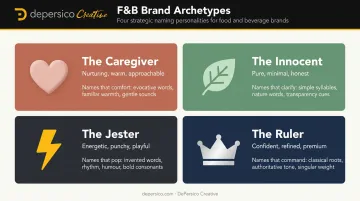
If a name candidate conflicts with the archetype, it doesn't matter how clever it is. Archetypes help teams say "no" faster — which is where naming efficiency lives.
Creative Linguistics: Beyond Brainstorming
Once the archetype filter rules out weak directions, creative linguistics shapes the language that remains. This means identifying the specific words, sounds, and phrases that create the strongest appetite appeal and emotional connection for a defined target audience — far more structured than a brainstorm session or word association exercise.
DePersico Creative's creative linguistics service filters every name candidate through four criteria: Relevance, Uniqueness, Simplicity, and Memorability. The output covers the brand name, taglines, product positioning lines, and front-of-pack copy. The name gets developed alongside the full language system it will live within.
Types of Brand Names Food and Beverage Companies Use
Choosing a name type is one of the first creative decisions — and each carries real strategic trade-offs that affect trademarkability, consumer understanding, and long-term brand equity.
| Name Type | What It Does | Trade-Off | F&B Example |
|---|---|---|---|
| Descriptive | Tells shoppers what the product is or contains | Easy to understand, hard to trademark, limited brand equity | 5-Hour Energy |
| Evocative/Metaphorical | Suggests an emotion, experience, or quality | Stronger equity potential, requires more brand building | Liquid Death |
| Invented/Coined | Fabricated word shaped phonetically | Highly trademarkable, owns its space, needs context | Häagen-Dazs |
| Founder/Heritage | Uses a person's name or place of origin | Signals authenticity and story, depends on founder narrative | Ben & Jerry's |
| Compound/Hybrid | Blends two relevant words or concepts | Communicates more with less, can feel clever | popchips |
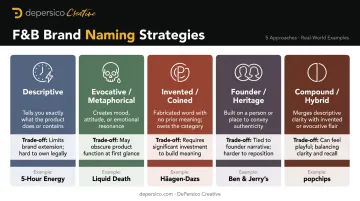
These examples each illustrate a different naming logic at work:
Häagen-Dazs is the clearest case study in invented naming. Reuben Mattus coined a completely meaningless, Danish-sounding name for an ice cream brand that started in the Bronx in 1960. The name communicated European artisan quality through phonetic association alone — no actual Danish connection required.
5-Hour Energy represents the opposite approach. The name is purely descriptive, and in this case, the clarity is the competitive advantage — a one-shot energy drink where the category was new enough that functional clarity mattered more than brand personality.
popchips shows how a compound name can embed a product story. The "pop" references the brand's heat-and-pressure preparation method, making the name functional and memorable simultaneously.
The right choice depends on the category, the competitive landscape, and how much brand-building investment the company can sustain — not on any universal hierarchy of name types.
The Brand Name Development Process: Step by Step
Brainstorm with Structure, Not Just Freedom
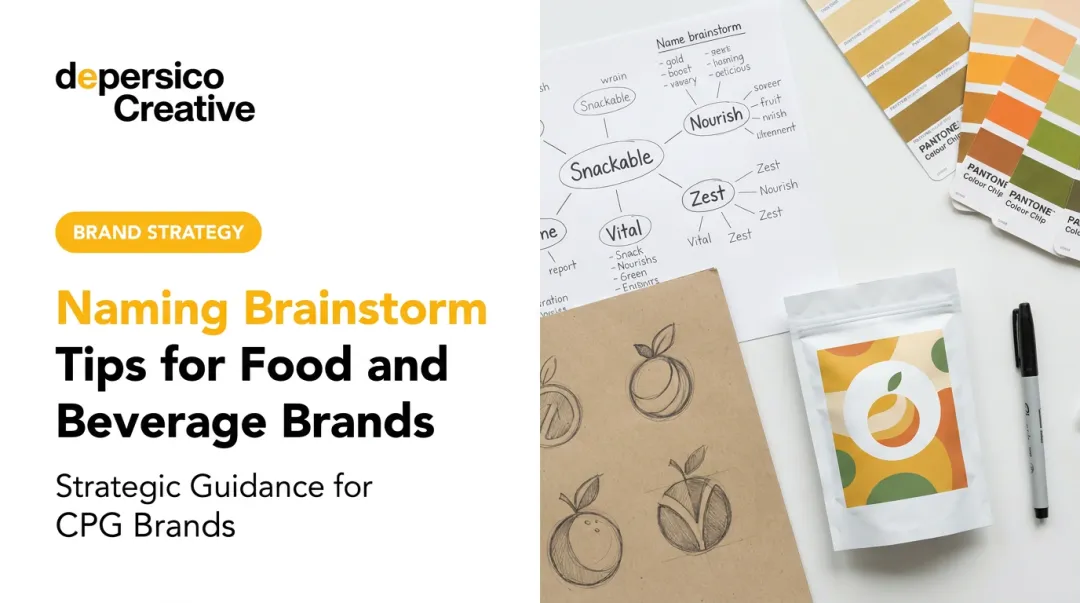
Productive F&B naming sessions are guided by the strategic themes identified before brainstorming — not by open-ended word association. The goal is to organize candidate generation around 2-3 thematic "ways in," such as:
- The ingredient or origin story
- The emotional benefit or eating occasion
- A brand personality trait
Generate candidates within each theme, by name type: existing words, invented words, compound blends, and metaphors. Volume matters in early rounds — the job here is generation, not editing. AI tools can help expand volume but tend to produce generic results. Human editorial judgment is what separates a long list from a useful one.
Screen Candidates Early and Objectively
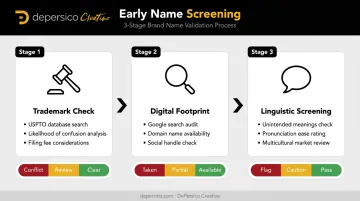
Before investing more time in any candidate, run a practical pre-screen:
- Initial trademark check — Search USPTO's Trademark Search database for existing registrations. Note that likelihood of confusion with a similar mark is a common refusal reason, and USPTO filing fees ($350 per class, base rate) are non-refundable after refusal.
- Google search — Search the name with relevant category descriptors to identify existing digital footprints.
- Domain and social handle check — Check .com availability and primary social platforms simultaneously.
Use a simple traffic-light system (red/yellow/green) to triage candidates efficiently. This prevents teams from falling in love with a name that has a fundamental legal or digital availability problem.
Linguistic screening deserves equal attention. Check that candidate names don't carry unintended meanings, negative connotations, or pronunciation challenges in languages relevant to your target markets — particularly for brands targeting multicultural consumers or planning national distribution.
A 2024 European Journal of Marketing study found that difficult-to-pronounce food brand names increased inferred processing concerns, suggesting pronunciation ease has real perceptual consequences for F&B brands.
Test Names in Context — Not in Isolation
A name that clears every internal review can still fall flat the moment it's placed on an actual package mock-up surrounded by competing products. Test names the way shoppers will actually encounter them:
- On packaging mock-ups, at shelf distance
- Spoken aloud — how does a cashier or shopper say it naturally?
- Written in a sentence alongside a product descriptor
- As a social media handle or thumbnail in an e-commerce listing
Feedback from target consumers matters here — not internal teams, not family members. The research should inform the decision, not make it. Brand leadership and naming experts need to make the final call, with consumer reaction as a data point rather than a verdict.
Validating and Protecting Your Food Brand Name
Once a shortlist of 2-4 finalist names is established, formal trademark screening by a qualified trademark attorney should happen before any other commitments are made. This involves:
- Checking existing trademarks in the correct Nice Classification classes — food products typically fall under Class 29 (meat, dairy, preserved foods), Class 30 (coffee, confectionery, sauces), Class 31 (fresh agricultural products), and Class 32 (non-alcoholic beverages)
- Evaluating both exact matches and phonetically similar marks
- Assessing geographic scope based on planned distribution
Trademark screening and digital availability go hand in hand — neither should wait on the other. A legally clear name can still create brand confusion or SEO headwinds if a similar name already dominates search results and social platforms. Secure the .com and relevant social handles at the same time trademark filing begins, not after the name feels final.
The most common validation mistake is falling in love with a name before completing this process. Finding a conflict at the validation stage is frustrating but manageable. Discovering a trademark issue after packaging has been printed and products are on shelf forces a full rebrand on a retailer's schedule, not yours — at full cost. Schedule validation as a fixed phase, not a final checkbox.
From Name to Shelf: Making Your Brand Name Work in Packaging
For food and beverage brands, a name is never experienced in isolation. It lives on the front of a package, alongside a logo, a color system, photography, and a product descriptor. The name and the package are a single system. Together, they either reinforce the same sensory promise and brand personality within seconds of shelf exposure — or they undermine each other.
What "Shelf-Ready" Actually Means
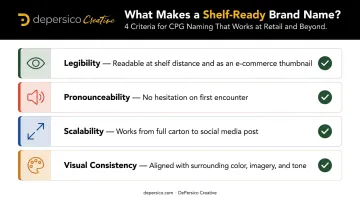
A shelf-ready name must:
- Be legible at a distance, both at full package scale and as a small thumbnail on an e-commerce listing
- Be pronounceable without hesitation by a shopper encountering it for the first time
- Work at different scales — full-size carton, individual serving pack, a social media post
- Feel consistent with the visual language surrounding it — not disconnected from the color, imagery, and tone of the package
Names that work beautifully in a slide presentation sometimes fail in real shelf context. They're too long, too abstract, or too similar to neighboring brands to register in the available attention window.
Evaluate the Name Inside the Package, Not Outside It
One of the most practically important steps in F&B naming is evaluating finalist names within actual packaging mock-ups — not in concept reviews or slide decks. A name's legibility, personality fit, and visual weight all depend on the typographic treatment, the color system, and the imagery that surrounds it.
DePersico Creative evaluates brand names within full package design context from the start. Working with brands like Ball Park, Idahoan, and Sea Best since 1977, the team knows that a name approved in a presentation doesn't always hold up when it's competing for attention on a crowded shelf.

Frequently Asked Questions
How do you develop a brand name?
Start with brand strategy — define your audience, positioning, and archetype before generating any candidates. Then brainstorm organized by theme and name type, pre-screen for trademark and digital conflicts, test finalist names with target consumers in real-world contexts (on packaging, spoken aloud), and complete formal trademark validation before finalizing. Strategy first, creativity second, validation last.
What are the 3 C's of brand development?
The 3 C's are Clarity (your brand communicates what it stands for), Consistency (messaging and identity are cohesive across all touchpoints), and Connection (the brand builds genuine emotional resonance with its audience). For F&B naming, a strong name should be clear enough to communicate positioning instantly and resonant enough to stick with the target shopper.
What are the 7 types of brand names?
The main name types relevant to food and beverage include: descriptive, evocative/metaphorical, invented/coined, founder/heritage, compound/hybrid, geographic, and abbreviated. The best choice depends on the brand's positioning, competitive landscape, and long-term growth goals — no single type works universally across all F&B categories.
What is the 3-7-27 rule of branding?
The 3-7-27 rule describes roughly how many exposures it takes for a consumer to notice a brand (3), remember it (7), and trust it (27). No single study pins these numbers exactly, but the principle holds — a forgettable name demands significantly more marketing spend to reach the same recognition a distinctive name earns faster.
What makes a food brand name stand out on store shelves?
Memorability, distinctiveness, and appetite appeal — working together with packaging design, color, and imagery to earn attention in the shelf decision window. A name functions as part of a visual system; it has to communicate the product's positioning and sensory promise before the shopper consciously decides to engage.
Should a food brand name describe the product or be evocative?
Purely descriptive names are easier for shoppers to understand immediately but harder to trademark and build lasting equity around. Evocative names offer stronger long-term brand potential but require more investment to establish category context. The right balance depends on the category, the competitive landscape, and whether the brand has the resources to build meaning around a less literal name over time.