Introduction
A shopper scans a grocery aisle and makes a selection in less than six seconds, according to NielsenIQ's 2024 retail analysis. Online, the window is even less forgiving — a thumbnail image either stops the scroll or doesn't.
Before a single word of copy is read, the photograph has already done its job — or failed to.
For CPG brand founders, this reality makes food photography one of the highest-leverage creative investments available. Yet many brands still treat it as an afterthought, capturing product shots at the end of a packaging project rather than treating photography as a strategic brand asset from the start.
This guide covers editorial food photography specifically: what it is, how it differs from standard product photography, what makes it technically effective, and how to use it to earn trial at the shelf and online.
Whether you're launching a new SKU or refreshing an established line, these are the principles that separate images that move product from images that just fill space.
Key Takeaways
- Editorial food photography tells a story — the full scene carries meaning, not just the food itself
- CPG brands need both commercial product shots and editorial lifestyle images; each serves a different job
- Lighting, angle, styling, and props work together — each one shapes what the final image communicates
- Photography must align with packaging design to create a coherent brand world across every touchpoint
- Brief your photographer on usage, mood, and consumer positioning before the shoot
What Is Editorial Food Photography (and Why It Matters for CPG Brands)
Defining the Discipline
Editorial food photography is photographic content designed to tell a story, express a point of view, and evoke an emotional response — rather than serve as a direct advertisement. It is characterized by artistic composition, intentional mood, and narrative-driven styling.
You encounter it in food magazines, cookbooks, brand websites, and campaign materials where the goal is to make the viewer feel something before they decide anything.
The defining characteristic is that the entire image carries the message — not just the food itself.
The background, props, lighting, and styling choices work together to create a feeling — a mood, a moment, a context — that the viewer connects with emotionally. A bowl of soup shot against a worn wooden table, steam rising, linen napkin beside it, tells a completely different story than the same soup photographed straight-on against white.
Why CPG Brands Can't Afford to Ignore It
Unlike a straight product shot, editorial-style food photography creates aspiration and context around the product. It helps shoppers visualize the food in their own lives — at breakfast, at a dinner party, after a long day — triggering the emotional response that makes them reach for the package.
NIQ Brandbank reports that 76% of online grocery shoppers prefer additional content while shopping. Lifestyle imagery, not just pack shots, is part of what they're looking for.
That appetite for context extends well beyond editorial pages. CPG brands apply this style of imagery across every major touchpoint:
- Social media feeds and paid advertising
- Brand websites and landing pages
- Retail point-of-sale displays
- E-commerce product detail pages (secondary images)
- Campaign and marketing materials
- Packaging support imagery
Editorial vs. Commercial Food Photography: Know the Difference
Most CPG founders treat these two styles as interchangeable. That's a problem — because using the wrong approach in the wrong context either kills appetite appeal or strips the brand story entirely.
Commercial Food Photography
Commercial photography puts the food front and center. The product dominates the frame, shot in maximum detail to emphasize texture, color, temperature, and appetite appeal. Every compositional choice serves one purpose: making the food look as irresistible as possible.
This is the approach used for:
- Front-of-pack hero shots
- E-commerce primary product images
- Retail catalog photography
- Close-up ingredient callouts
Editorial Food Photography
Editorial photography prioritizes the full visual story of a scene. The food may occupy less of the frame, with backgrounds, surfaces, props, and ambient atmosphere contributing equally to the story being told. The result feels less like a product display and more like a moment someone stumbled into.
The practical difference: a commercial shot makes you want the food. An editorial shot makes you want the life the food represents.
What CPG Founders Actually Need
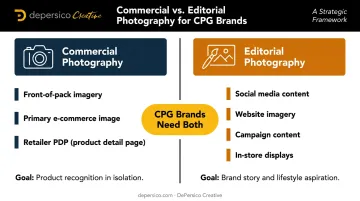
Most brands need both — used strategically, not interchangeably.
| Photography Type | Primary Use Cases | Goal |
|---|---|---|
| Commercial | Front-of-pack, primary e-commerce image, retailer PDP | Product recognition and appetite appeal in isolation |
| Editorial | Social media, website lifestyle pages, campaign content, in-store displays | Brand story, emotional context, lifestyle aspiration |
The common mistake: Using only one style across all applications. Purely clinical product shots feel cold and transactional. Purely editorial images are beautiful but may not clearly communicate what the product actually is. A deliberate visual strategy assigns each style to the channels where it performs best — and that mapping should be decided before a single shot is taken.
The Core Elements That Make Editorial Food Photography Work
Lighting
Lighting is the single most powerful variable in food photography. It determines mood, texture visibility, and dimensional depth — before a single prop is placed.
- Side lighting rakes across food surfaces, revealing texture and making ingredients look more three-dimensional
- Back lighting creates rim light and translucency, particularly effective for liquids, soups, and foods with natural gloss
- Soft light (diffused through a window or scrim) creates an airy, clean, natural feel
- Hard light creates dramatic shadows and a bolder, moodier result
The direction, quality, and color temperature of light set the entire emotional register of an image. Warm, low light evokes comfort and indulgence. Cool, bright light reads as fresh and healthy. These are deliberate choices, made before the first frame is captured.
Composition and Camera Angle
Two camera positions dominate food photography, each with specific strengths:
- 90-degree overhead (flat lay): Creates graphic, pattern-driven compositions ideal for foods with visual interest across a flat plane — charcuterie boards, grain bowls, pizza, baked goods
- 45-degree angle: Mirrors how a person naturally sees food at a table; adds depth, allows layering of elements, works well for soups, stacked dishes, and plated meals with height
- Eye-level or low angle: Reveals height and structural layers — ideal for burgers, layer cakes, or stacked sandwiches
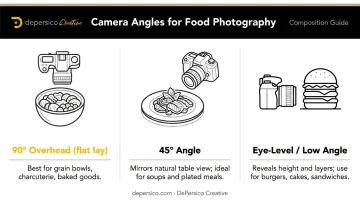
The choice of angle should be driven by what makes the specific food most compelling, not by a blanket preference.
Food Styling
Professional food styling is what separates a snapshot from an image that stops people mid-scroll. The core concept is the hero dish — a carefully prepared, visually perfected version of the food that is shot quickly before natural deterioration begins.
Stylists use tools most photographers don't carry:
- Stand-in dishes for lighting setup to preserve the hero's freshness
- Brushes, eyedroppers, and spray bottles to maintain surface sheen and moisture
- Strategic ingredient placement to guide the viewer's eye through the frame
- Selective color and texture contrast to make the hero element read immediately
For CPG brands, food styling must also stay true to what the product actually looks like — there's a meaningful difference between enhancing natural appeal and misrepresenting the product.
Set Design and Props
Food styling addresses the dish itself. The set is everything surrounding it, and every element makes a statement about the brand. Backgrounds, surfaces, linens, cookware, and secondary props are storytelling tools, not decoration.
The right choices depend entirely on brand identity:
- A rustic bread brand uses weathered wood, flour-dusted linen, and ceramic dishes
- A clean-label snack brand uses marble, white ceramics, and natural light
- A bold, globally-inspired sauce uses deep colors, layered textiles, and abundant ingredients
Props chosen to reflect the brand's identity strengthen the image. Anything that doesn't serve the narrative should be removed.
The Full Image as Storytelling
When all of these elements work together, the result is an image that communicates a lifestyle, a season, an occasion, or a feeling before the viewer consciously reads anything. For CPG brands, that's the difference between an image a shopper scrolls past and one that makes them pause, feel something, and reach for the package.

How Editorial Food Photography Connects to Your CPG Brand Identity
Photography Doesn't Exist in Isolation
The most technically accomplished food photograph will still underperform if it sends different signals than the packaging beside it. Color palette, mood, and aesthetic must be consistent across photography, packaging design, typography, and brand positioning — otherwise shoppers receive mixed messages at the shelf and online, and the brand fails to build the recognition it needs.
Achieving that coherence requires the people making photography decisions to understand the packaging strategy — and vice versa.
Building a Visual Brand World
A visual brand world is the sum total of imagery, color, texture, and style that makes a brand immediately recognizable before a shopper reads the name. For CPG brands, editorial food photography is one of the primary tools used to build and extend this world beyond the package itself.
Think of packaging as home base. Photography extends that world into every channel where consumers encounter the brand:
- Instagram feed and social content
- Website homepage and landing pages
- In-store displays and shelf signage
- E-commerce listings and digital ads
When these touchpoints share a cohesive visual language, brands build recognition faster and earn trust more readily.
NIQ data shows that optimized CPG packaging can affect forecasted volume by up to 5.5% — but 90% of redesigns fail to create meaningful in-market impact. One consistent finding: brands that don't maintain visual coherence across their full system leave results on the table.
The Case for Integrated Creative
Agencies like DePersico Creative, which handle both food photography and package design under one roof with an in-house studio and test kitchen, ensure that the product on the shelf and the imagery used across marketing channels exist within the same visual world. When the photographer understands the packaging strategy and the design team has input on how the photography will extend the brand, every channel the brand occupies reinforces the same message — which is what drives recognition and trial at shelf.

What to Look for in a Food Photography Partner
Not every commercial photographer is equipped to serve a CPG brand. The discipline is specific enough that generalist experience creates real gaps.
Start by looking for food and CPG specialization — not just photography experience. Food photography demands specific knowledge: styling for different textures (crispy vs. saucy vs. layered), lighting that flatters specific food categories, and the multi-format requirements of CPG marketing. Packaging shots, mobile hero images, retail displays, and paid social all have different compositional needs.
Portfolio range matters just as much. Can they shoot tight commercial hero shots and wide editorial lifestyle scenes? The best partners show that they understand how each image serves a brand's business goals — not just that they can make food look attractive.
Integration is the third factor to evaluate. A partner who connects photography with packaging design and brand strategy produces imagery that works across packaging, social, and retail. An agency with an in-house test kitchen and studio — like DePersico Creative — can prepare, style, and shoot food in a controlled, brand-aware environment, rather than receiving finished food off-site with no room to adjust.
Questions worth asking any potential partner:
- Have you worked with CPG brands in similar categories?
- Can you show examples of both commercial and editorial food photography from the same project?
- How do you ensure what you shoot aligns with the packaging and brand identity?
- Who handles food styling, and how is it integrated into the shoot?
How to Brief Your Food Photographer for Maximum Impact
A well-prepared brief prevents expensive reshoots and ensures the final images serve the business — not just look good in isolation.
Step 1: Define Usage Upfront
Start by answering one question: where will these images appear?
- Packaging requires specific dimensions, bleed requirements, and compositional space for type overlays
- Social media favors square or vertical crops with immediate visual impact at small sizes
- E-commerce primary images often require white or clean backgrounds
- Retail displays may need horizontal formats with open space for copy
Share this information before the shoot. Images composed without knowing their final usage often fail technically, regardless of how well they're lit or styled.
Step 2: Build a Visual Mood Board
Prepare a mood board of 5–10 images that represent the target look, feel, and emotional tone. Include:
- Color temperature (warm vs. cool, light vs. dark)
- Surface and texture references (wood, marble, linen, concrete)
- Prop and styling aesthetic (rustic, minimal, abundant, refined)
- Lifestyle context (who is in or implied by the frame)
Non-food images often communicate emotional tone better than food photography references. A page of fashion or interior design imagery can align a photographer to your brand's world faster than ten food shots from competitors. Specificity here saves hours of back-and-forth before the camera turns on.
Step 3: Define the Hero and Its Story
Answer these questions in writing before the photographer arrives:
- What does the food look, smell, and taste like — and how should the image communicate that?
- What occasion or lifestyle does this product belong to?
- Who is the target consumer, and what should the imagery make them feel?
- What is the single most important thing the image must communicate?
A photographer who understands your positioning — not just your product — can make real-time decisions on set that align with your brand. Without that context, even technically strong images can end up serving the wrong audience or selling the wrong moment.
Frequently Asked Questions
What is editorial food photography?
Editorial food photography is story-driven, aesthetically composed imagery designed to evoke emotion and express a point of view. Unlike advertising photography, the entire scene — background, props, lighting, and context — carries meaning alongside the food itself.
How much does a professional food photographer cost?
Costs vary based on the photographer's experience, shoot complexity, whether food styling is included, and usage rights. Request an itemized quote that separates creative fees, styling, production expenses, post-production, and usage licensing before comparing partners.
What is the difference between editorial and commercial food photography?
Commercial photography centers on food detail with the product dominant in the frame, designed to sell the item in isolation. Editorial photography treats the full scene — setting, props, atmosphere — as equally important as the food itself, engaging and inspiring rather than simply displaying.
Do CPG brands need a food stylist for their photography?
Yes. Food degrades quickly under studio lighting, and a professional stylist ensures the hero dish looks its best at the exact moment of capture. Styling also ensures the food accurately represents the product while maximizing its visual appeal.
How does editorial food photography help a CPG product stand out on shelves?
Editorial photography builds a brand world and emotional identity that extends beyond the package itself. When consumers recognize a brand's visual world before they read the label, the shelf decision becomes faster and more instinctive. That recognition is often what separates a product that gets picked up from one that gets passed over.